2026 World Cup Opening Shows: Records & Stats That Will Blow Your Mind
Football is passion, but a World Cup opening show is pure math. Behind every choreography, every firework, and every international star lie tens of thousands of hours of work, millions of dollars, and records waiting to be broken. And for the 2026 World Cup —the first with three host nations: Mexico, the United States, and Canada— the opening spectacle will be no exception. Here’s a statistical analysis with hard data and a fresh angle: the numbers behind the magic.
The Numbers That Define a Global Spectacle
Every World Cup edition has tried to outdo the last. For 2026, the figures will be colossal. Let’s look at key stats from the five most recent opening ceremonies and projections for this tri-nation event.
Investment in opening shows has grown exponentially. South Africa 2010 cost about $40 million. Brazil 2014 soared to $50 million. Russia 2018 invested $65 million in its massive Luzhniki Stadium production. Qatar 2022 broke the bank with $180 million for a 30-minute show featuring drones, holograms, and a performance by BTS’s Jung Kook.
For 2026, with three venues and the need to connect continents, the total budget for the opening show is estimated to surpass $300 million, making it the most expensive in history. The logistical challenge of synchronizing acts in Mexico City, Los Angeles, and Toronto (or Vancouver) multiplies costs.
Duration and Number of Artists: Bigger, More Epic
The show length has gone from 20-25 minutes to nearly an hour. Qatar 2022 lasted exactly 30 minutes. In 2026, a 40- to 50-minute show is expected, with a cast of over 5,000 live performers (dancers, musicians, acrobats), not counting technical and production crews.
Statistically, each minute of show requires 2,000 hours of rehearsal and 100 people behind the cameras. If the show runs 50 minutes, that’s 100,000 hours of work just in preparation.
Television Audience: The Real Record
The global audience for the World Cup opening is one of the most-watched TV events. Qatar 2022 was seen by 1.8 billion people worldwide (FIFA estimates). Brazil 2014 reached 1.5 billion. For 2026, with three time zones (CDMX GMT-6, US East GMT-5, Pacific GMT-7, and Toronto GMT-5), a 12-hour live coverage is expected, which could surpass 2.5 billion unique viewers. It will be the most-watched opening event ever.
Technological Innovation and Records at Stake
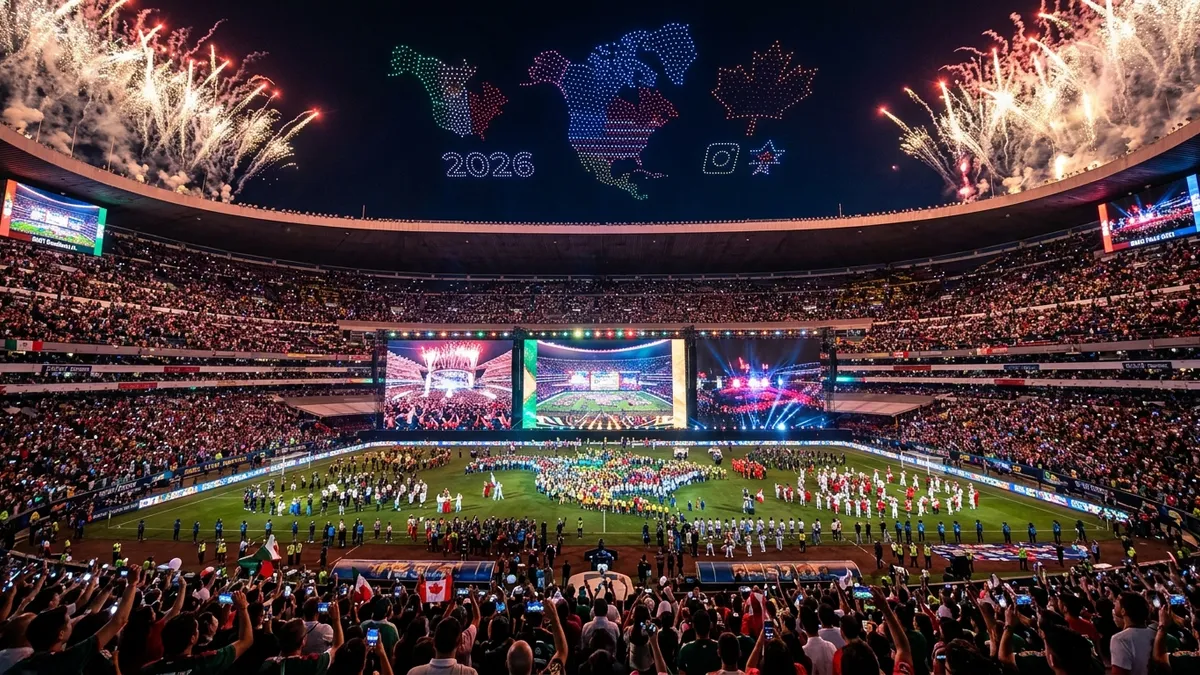
The show isn’t just about numbers. Technologies used in shows have evolved. In 2018, Russia used 1,500 drones lighting the sky. Qatar broke the record with 2,200 synchronized drones. For 2026, the drone count could exceed 5,000, forming 3D figures across the three venues.
Also, augmented reality in broadcasts will be key. It’s projected that 60% of viewers will watch the show on screens, so production will invest in AI-generated graphics to create impossible live effects. For reference, Qatar 2022 used 12 high-speed cinema cameras to capture every detail. In 2026, at least 30 8K cameras and the first full 16K broadcast on digital platforms are expected.
The Official Song Record
The World Cup song has historically been part of the opening show. From Shakira’s "Waka Waka" (2010) to "Hayya Hayya" in 2022, streaming plays number in the hundreds of millions. For 2026, bets are on an international collaboration bringing together artists from Mexico, the US, and Canada. Statistically, the most successful recent World Cup song has 1.5 billion YouTube plays. The 2026 song could break the 2 billion barrier.
The Logistical Challenge of Three Countries
Here’s the fresh angle of this article: never before has a World Cup had to open in three countries simultaneously. FIFA plans a main show (likely at Mexico’s Estadio Azteca, site of the first match) with live acts at the other two venues via giant screens and real-time connections.
Statistically, the time difference between Mexico City and Vancouver is 2 hours, forcing organizers to coordinate two primetime slots: one for the Americas and one for the rest of the world. The production crew is estimated at 3,000 technicians just for live broadcasts.
Additionally, security measures multiply: Qatar deployed 50,000 security personnel for the opening event. With three countries, the figure could exceed 100,000, including anti-terrorism and health protocols.
What Awaits Us in 2026? Data-Based Projections
Extrapolating trends, the 2026 World Cup opening show will be a statistical milestone:
Cost: $300-400 million.
Duration: 45-50 minutes.
Live performers: Over 6,000.
Drones: 5,000+ (world record).
Global audience: 2.5 billion people.
Countries live-connected: 3 (simultaneous broadcast).
Production hours: Over 200,000.
CO₂ tonnes: Estimated at 12,000 (with mandatory offsets).
FIFA has already announced the opening show motto: "United by Football," reflecting the union of three nations. The numbers, however, speak of a race to break all records. Will they succeed? If history is any guide, football and spectacle always find a way to lift us.
Get ready. 2026 won’t just be a World Cup; it will be a symphony of data, emotions, and grandeur. See you at the show!