#extreme poverty players#footballers who overcame poverty#Maradona Villa Fiorito story#Rivaldo favela world champion#world cup football stories#Latin American football poverty
Players who escaped extreme poverty to play in a World Cup
June 16, 2026 8 min readPrediPick
Maradona, Rivaldo, Cuadrado and more: the most incredible stories of players who rose from extreme poverty to play in a World Cup.
There was a boy who slept with seven siblings in a room two meters by two. Another who sold bracelets on the beach to eat, while his teeth rotted from malnutrition. Another who watched his mother pretend to have a stomach ache so her children could eat the little that was there. All of them, years later, stepped onto a World Cup stadium with millions of eyes watching them.
Football has historically been the most powerful social elevator in sports. In no other sport in the world can a barefoot child from a favela end up lifting a World Cup. These are the stories of those who made it.
Before talking about glory, we must talk about context. According to World Bank data, more than 700 million people live in extreme poverty on the planet, most concentrated in sub-Saharan Africa, South Asia, and Latin America—precisely the regions that have produced the brightest players in football history.
This is no coincidence. In neighborhoods without educational or job opportunities, the football becomes the only possible currency. No expensive equipment needed, no academy fees required. All you need is a ball—sometimes not even that, sometimes a sock stuffed with rags—and a space to dream.
That is the cradle of many of the best footballers who have played in a World Cup. And these are their stories.
Diego Armando Maradona: "If I say Fiorito, I say struggle"
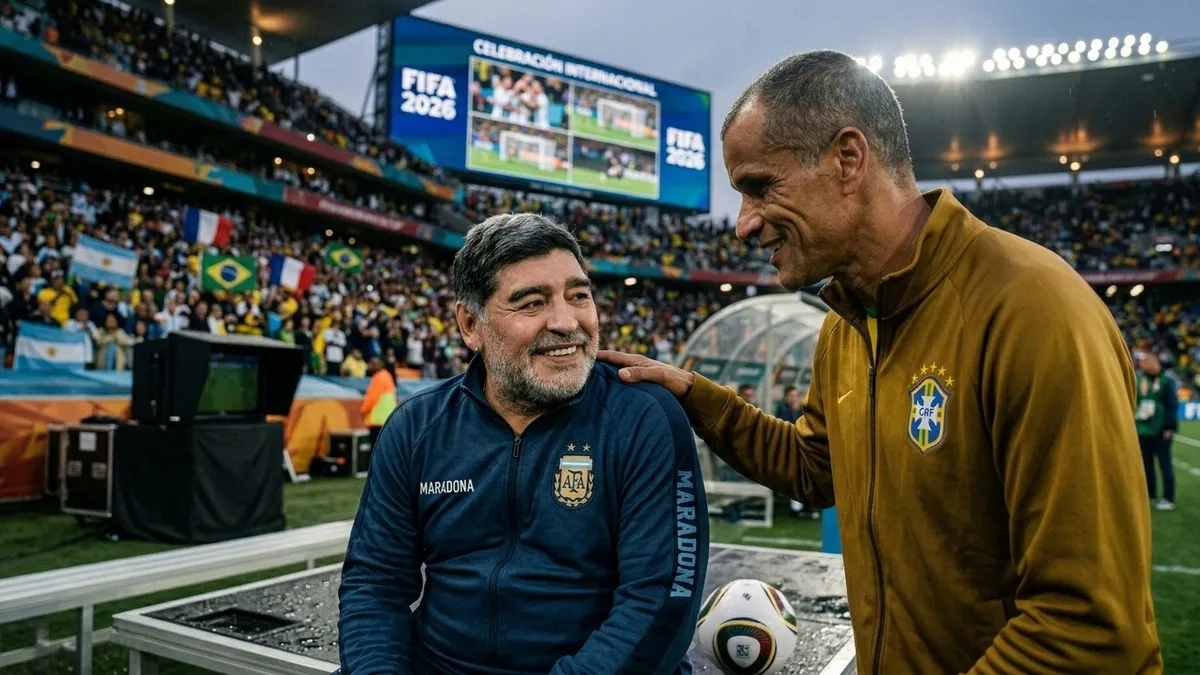
There is no more powerful story of overcoming in football than that of Diego Armando Maradona. He was born on October 30, 1960, in Villa Fiorito, one of the poorest and most neglected areas of Greater Buenos Aires.
The tin and wood house
His father was a worker. His mother, a housewife. There were eight siblings squeezed into a tin and wood house with a dining room and two bedrooms. On the left, the children's room: no more than two meters by two.
There was never enough food. Maradona remembered it all his life with a heartbreaking phrase: "My mom used to say her stomach hurt so we could eat. At 13, I realized my old lady had never suffered from her stomach."
He learned to play on the dusty fields of Fiorito. Without shoes. Without pitches. With nothing but immense talent and an urgent need to escape.
The leap to the world
By age 10, he was already dazzling with "Los Cebollitas" of Argentinos Juniors. At 16, he debuted in the First Division. And in the 1986 World Cup in Mexico, that boy from Villa Fiorito led Argentina to win their second World Cup, playing the Goal of the Century and the controversial "Hand of God" against England.
Interestingly, the shirt he wore for those immortal plays was made as an emergency in the workshops of Tepito, the most popular neighborhood in Mexico City. Decades later, that garment was auctioned for more than 9 million dollars.
From the mud of Fiorito to 9 million. That's how brutal Maradona's journey was.
Rivaldo: teeth rotted from malnutrition
If Maradona is the South American symbol of overcoming, Rivaldo is the Brazilian symbol of extreme suffering turned into glory.
Childhood in the Recife favela
Vitor Borba Ferreira Gomes was born on April 19, 1972, in Recife, Pernambuco state, in northeastern Brazil. He grew up in the port favelas, a few kilometers from the tourist-filled beaches, but in a completely different world: without enough food, without shoes, without a visible future.
The extreme poverty he lived in was etched into his own body: he suffered severe malnutrition and lost several teeth that rotted before he was ten. To survive, he would walk the beaches of Recife selling whatever he could: bracelets, drinks, candies. His father, Romildo, died in a traffic accident when Rivaldo was barely 16.
15 kilometers walking to training
When he started his career at Paulistano at age 16, he had no money for transport. The 15 kilometers separating his favela from the training ground he covered on foot, every single day. That daily walk, according to reports, shaped his characteristic bowed legs.
From rejection to world glory
He was turned down by several clubs for being "too skinny". No one saw in that bony, malnourished boy the future best player on the planet. But Rivaldo silenced them all.
At the 2002 World Cup in Korea-Japan, he scored in five of Brazil's seven matches and was named to the Tournament's All-Star Team. That year, Brazil lifted their fifth World Cup. The boy who walked the beaches barefoot ended up being a world champion at 30.
Arturo Vidal: "I know it can't be worse than it was back then"
The story of Arturo Vidal has a central image that defines it all: a 13-year-old teenager seeing his mother come home completely exhausted after a grueling day of work.
Dirt streets in El Huasco
Vidal grew up in El Huasco, a humble settlement in the San Joaquín commune of Santiago, Chile. His childhood was marked by hunger and cold. His mother worked nonstop to support her children, and even so, it wasn't enough.
That image of his mother arriving exhausted at home was the turning point. Vidal put it precisely: "I thought: this can't happen again. And I decided to put in three, four, ten times more effort than anyone else in every training session."
He learned to play on the dirt streets of El Huasco. Without an academy, without infrastructure, with nothing but will and rage.
From the dirt field to Bayern Munich
Vidal went on to play for Bayern Munich, Juventus, and Barcelona, among other giants. He participated in the 2010 South Africa, 2014 Brazil, and 2018 Russia World Cups with the Chilean national team. In 2015, he was a key player in winning the Copa América, Chile's first title in that tournament.
His mother never had to give up again.
Juan Guillermo Cuadrado: football or crime
The story of Juan Guillermo Cuadrado has an element that sets it apart from all the others: he had to escape not only hunger but also bullets.
Born in Urabá
Cuadrado was born in Necoclí, Urabá (Colombia), a region devastated for years by drug trafficking and violence. As a child, he witnessed something that would mark his life forever: hiding under a bed, he saw criminals murder his father.
He had to avoid not only hunger but also bad company, threats, and the temptations of organized crime. Football was literally the difference between life and death.
From danger to Juventus
Cuadrado had to leave his hometown to escape that past. Football took him to Juventus of Turin, where he played alongside stars like Cristiano Ronaldo. With the Colombian national team, he played in the 2014 Brazil and 2018 Russia World Cups, becoming one of the most dazzling footballers of his generation.
Enner Valencia: from the countryside to the world's stadiums
Ecuadorian Enner Valencia never hid his origins. On the contrary, he carries them with pride. He was born in Ricaurte, 10 kilometers from San Lorenzo, in the province of Esmeraldas, and his childhood was spent planting, harvesting, milking, and walking alongside his father's cattle.
Football was not an abstract dream for him: it was a concrete need. A way to help a family that lived on just enough in a rural area of Ecuador.
Valencia became the all-time top scorer for the Ecuadorian national team and represented the country in the 2014 Brazil and 2022 Qatar World Cups, where he was Ecuador's star in the group stage, scoring the first goal of the tournament against the host nation.
What unites all these players
Beyond their cultural and geographical differences, these players share a common denominator: football was not a hobby; it was a survival mission.
None of them had elite academies, nutritionists, sports psychologists, or professional infrastructure in their childhood. What they had was hunger—literal and metaphorical—and a ball that became their passport to the world.
The World Cup, in that sense, is not just a sporting competition for them. It is tangible proof that the journey was real, that the sacrifice was worthwhile, that the barefoot child from the favela or the dusty field reached the greatest stage a footballer can step on.
Did you know...?
Maradona never forgot where he came from: Years after being world champion, he returned to Villa Fiorito with a truck full of toys and gifts for the neighborhood children. He did it without cameras, without press releases. Just because.
Ronaldinho also lived this story: The Brazilian lost his father when he was 8, and his family survived on the bare minimum in a precarious neighborhood of Porto Alegre. Between 2004 and 2008, while being the best player in the world, he earned more than 50 million dollars a year. No algorithm can calculate that distance.
Moisés Caicedo left home at 15: The Ecuadorian midfielder, now a star in the Premier League, left his mother's home as a teenager to seek a better future—not only for himself but for his parents and his 10 siblings. In countries like Ecuador, football is a family industry.
World football cannot be understood without these stories. Every time a player looks up to the sky after a goal in a World Cup, behind that gesture there is a neighborhood, a mother, a hardship, and a promise kept. The World Cup is not only the greatest trophy in sports: it is also the greatest monument to human resilience.