Adidas Trionda: The AI Soccer Ball You Charge Like a Phone
June 13, 2026 6 min readPrediPick
Adidas Trionda: The AI Soccer Ball You Charge Like a Phone
For the first time in World Cup history, the official match ball needs to be connected to a charging dock before every game. The new Adidas Trionda is not just a high-performance sphere: it's a smart device that integrates sensors, real-time data transmission, and a wireless charging system similar to that of mobile phones. This novelty is not a simple aesthetic update; it represents a qualitative leap in the relationship between technology and sport, and marks a before-and-after in stadium logistics in the United States, Mexico, and Canada.
To understand the magnitude of this change, we need to look back. The first World Cup balls, like the Tiento from Uruguay 1930 (made of hand-stitched leather with rubber strips), absorbed water during matches and could double in weight. In the 1960s, the Adidas Telstar with its 32 black-and-white panels became a visual icon and improved television visibility. Then came synthetic layers, thermal bonding, and computer-aided aerodynamics.
But the 2026 World Cup marks a new turning point: for the first time, the official ball needs to be recharged before each match. It is no longer just a passive object to be kicked; it is a mobile sensor that collects information and sends it to refereeing and analysis systems in real time.
Before each game, team attendants place the official balls on charging docks located inside the stadiums of the United States, Mexico, and Canada, exactly like everyday electronic devices.
This routine, which might seem trivial, implies a cultural shift: soccer is moving toward the paradigm of e-sports, where battery life and connectivity are as important as the condition of the pitch.
The Technological Core of the Adidas Trionda
The Trionda is not an ordinary ball. Its external structure, with only four panels, already breaks with the 32, 14, or 6-panel designs we've seen before. But what really matters is inside.
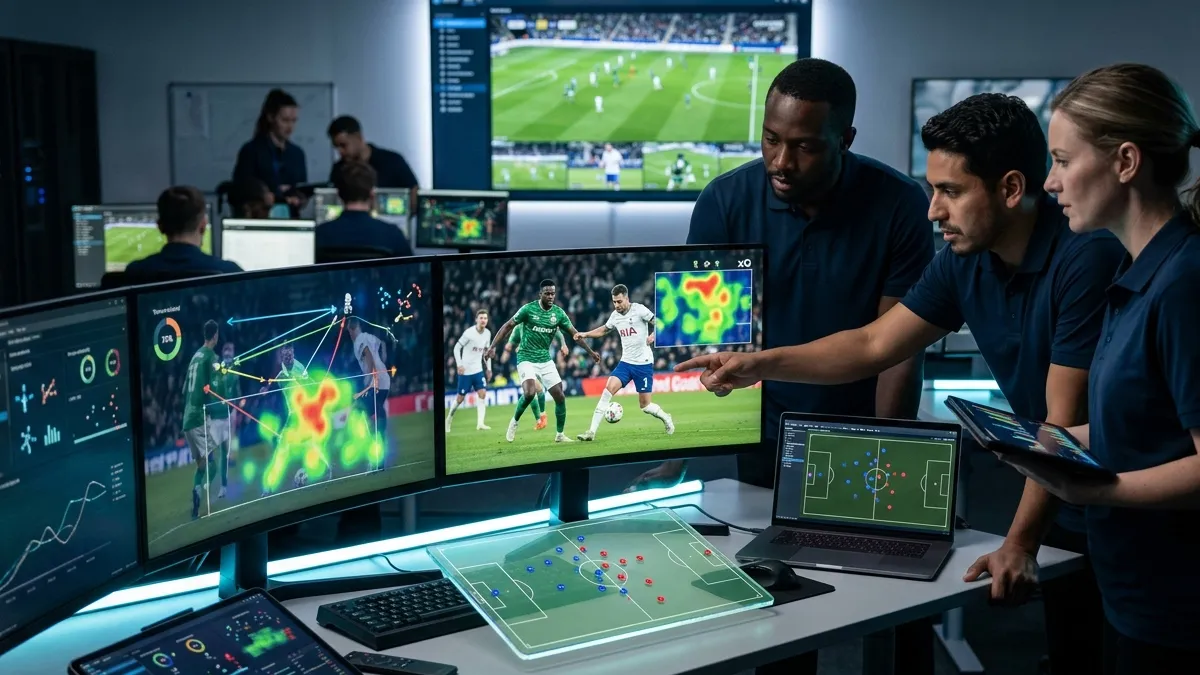
High-precision internal sensors: The ball features a state-of-the-art gyroscope and accelerometer that record rotation speed, linear acceleration, trajectory, and the exact point of impact. This data is transmitted in real time to video assistant referee (VAR) systems and coaches' screens.
Wireless data transmission: It integrates a low-latency radio frequency chip that sends the information to a receiver on the sidelines. This allows, for example, automatically determining whether a goal was valid or if a foul occurred at the moment of the shot, without waiting for replays.
Inductive wireless charging: The ball is placed on a specially designed base, similar to those we use for phones. A full charge takes about three hours and provides power for the entire match (roughly 90 minutes of active play). The lithium-ion batteries are ultra-lightweight and protected by a flexible polymer casing.
Four panels and deep seams: As for its exterior technology, the four-panel structure includes intentionally deep seams. This creates a surface that provides ideal stability when moving through the air, ensuring exceptional aerodynamic resistance distributed evenly. Adidas designers have studied thousands of trajectories in wind tunnels to prevent erratic ball behavior.
Secret Graphics for Grip Under Rain
Likewise, the graphics printed on the ball, which can only be seen up close, enhance grip when striking or handling the ball in rain or high humidity conditions. These microscopic patterns, inspired by the skin texture of some desert reptiles, create channels that divert water and maintain traction. This is not just an aesthetic design; it is engineering applied to ball control.
What Does This Mean for the Game?
Introducing a ball with AI and wireless charging is not a marketing gimmick. It has real consequences on the field:
1. Ball-Assisted Refereeing
VAR already uses cameras, but with the Trionda it will have an objective data point of the exact moment the ball is touched. This is crucial for determining offsides, fouls inside the area, or whether the ball has completely left the field. Real-time data transmission from inside the ball eliminates the margins of error that previously relied on human decisions.
2. Live Tactical Analysis
Coaching staffs will receive a data stream on the speed of each shot, ball rotation, and pass accuracy. This will allow strategy adjustments during halftime. For example, if the sensor detects that a player is shooting with low power, the coach can change the offensive scheme.
3. New Metrics for Fans
Television broadcasts and mobile apps will be able to display the exact speed of each shot, the curved trajectory the ball took, or the power of the pass. Soccer will become more quantifiable, offering viewers a more immersive experience.
Is It Necessary to Charge the Ball? Overcoming Cultural Friction
The inevitable question is: why does a ball need charging? The answer is simple: sensors and transmitter consume energy. Although batteries have an estimated lifespan of 150 minutes of continuous use, Adidas has designed the charging system to be fast and safe. The stadium protocol will include:
Pre-match charging: 10 balls (5 per half) will be placed on charging bases two hours before kickoff.
Dynamic replacement: If a ball is kicked out of the stadium during a celebration or suffers excessive impact, the fourth official will have another charged ball on the sidelines.
Resistance to moisture and heat: The batteries are hermetically sealed and can withstand temperatures from -10°C to 50°C, covering all climates in North America.
Some purists may argue that this dehumanizes the sport. But the reality is that football has already incorporated VAR, referee cameras, and sensors in jerseys. The smart ball is the next natural step. As an Adidas executive noted during the presentation: “It's not about removing emotion, but about giving more tools to make the game fairer and more spectacular.”
Looking to the Future: Balls That Learn?
The Adidas Trionda is not the end of the road, but the beginning. The artificial intelligence technology integrated into the ball can learn each team's playing patterns. In the near future, it could send tactical recommendations in real time or predict the trajectory of a free kick before the player strikes. For now, we have a ball that needs to be plugged in, but promises to transform every match of the 2026 World Cup.
In the stadiums of the United States, Mexico, and Canada, the team attendants will have already memorized the ritual: placing the balls on the charging docks, waiting for the green light, and handing them to the captains. Soccer enters the era of rechargeable energy. And the game will never be the same again.