2026 World Cup jersey sales break historic records
June 21, 2026 4 min readPrediPick
2026 World Cup jersey sales break historic records before the tournament
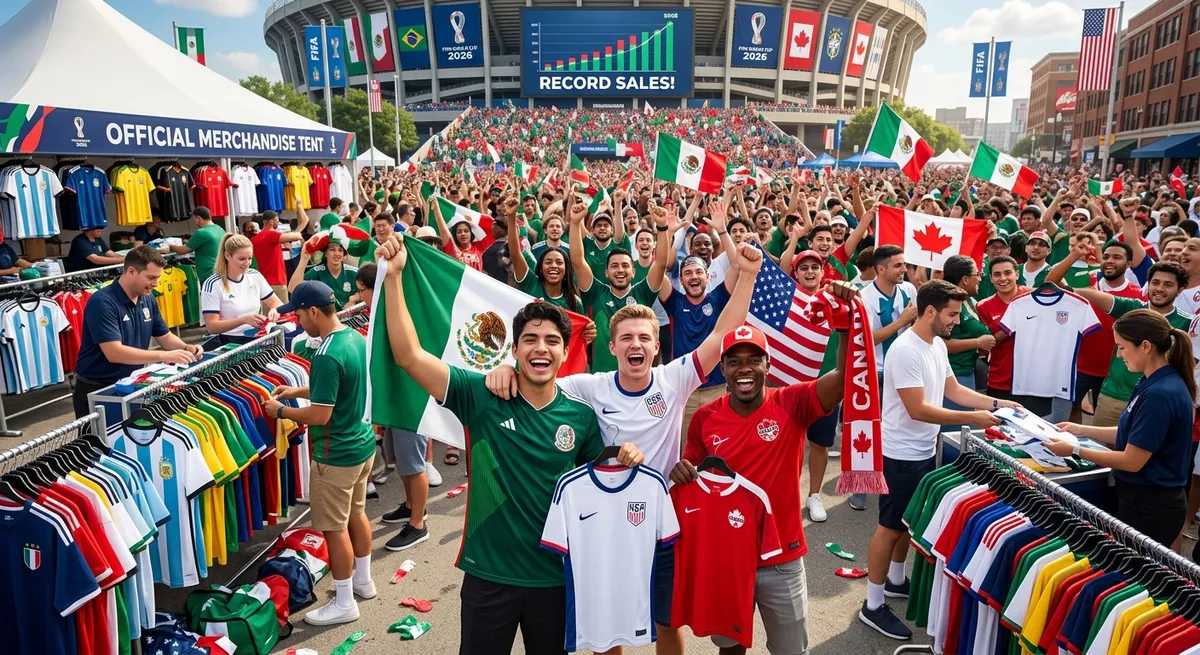
Since the start of the FIFA 2026 World Cup, official jersey sales have already surpassed any previous World Cup record. According to data leaked by sources close to FIFA, cumulative global orders through May 2026 double those for the same window in Qatar 2022 and triple those for Russia 2018.
The phenomenon, driven by the combination of three host nations (Mexico, the United States, and Canada), a new 48-team structure, and a North American market hungry for sports merchandise, has turned tournament apparel into an unprecedented object of desire.
The sports retail consultancy GlobalSport Analytics estimates that in the first quarter of 2026 alone, more than 25 million official jerseys were sold across all participating teams. This figure represents a 118% increase over the same period in 2022 and a 207% jump compared to 2018.
"We've never seen such a strong start. Current numbers already exceed the total sales of some entire previous editions," Luis Fernández, senior analyst at the consultancy, told this outlet. "The multiple-host factor and the huge purchasing power of the American public have created a perfect storm."
Comparison between editions
Edition
Cumulative sales (pre-tournament)
Difference vs. 2026
2026 (projected)
25.2 million
–
2022
7.1 million
–53%
2018
4.9 million
–68%
2014
3.8 million
–75%
The data includes jerseys from both the host nations (Mexico, United States, and Canada) and the major powers: Brazil, Argentina, Germany, France, and England. However, the most explosive growth is seen in the shirts of Mexico and the United States, which together account for 40% of the total.
The impact of the trinational format
For the first time in history, the World Cup is organized by three countries. This decision, far from diluting interest, has multiplied physical and digital points of sale. "The strategy of launching exclusive designs for each host city, with details that pay homage to local cultures, has been a hit," explained Mónica Reyes, marketing director for one of the tournament's official brands.
The limited-edition jerseys for host cities (Mexico City, New York, Los Angeles, Toronto, among others) sold out in less than 48 hours. "At the Foro Sol on launch day, lines of over 4,000 people formed," recounted Jorge Palacios, a Mexican fan who camped out for 12 hours to get his.
The fever reaches digital markets too
Platforms like Mercado Libre, Amazon, and StockX report a record number of listings for U.S. and Mexican national team jerseys over the past five months. Resale prices for commemorative versions have quintupled the original value, a phenomenon analysts attribute to the artificial scarcity created by high demand and still-limited production.
"We're seeing speculative behavior typical of collectibles, similar to sneakers," noted David Chen, sports economist at Columbia University. "The 2026 Cup isn't just a sporting event; it has become a cultural and commercial phenomenon that transcends football."
Statements from FIFA
FIFA's marketing director, Thomas Wagner, stated in a virtual press conference that the organization is "astonished" by the public's response. "We expected a strong performance, but these numbers have forced us to revise our production upward to avoid shortages during the tournament," he said.
Wagner also announced that new versions of jerseys for qualified teams will be launched as groups are defined, including special editions for each round. "We want every fan to feel they have a unique piece of history," he added.
Which teams lead sales?
According to FIFA's unofficial internal ranking, the five best-selling jerseys as of March 2026 are:
Mexico – 3.8 million units
United States – 3.2 million
Argentina – 2.5 million (reigning world champions)
Brazil – 2.1 million
Canada – 1.4 million (historic record for the country)
Canada's presence in the top 5 is one of the surprises. The Canadian national team, which barely participated in 1986 and 2022, has seen more than 600% growth compared to its pre-Qatar 2022 sales. "Soccer is exploding in the country, and this will be our first home World Cup," celebrated Emma Larocque, spokesperson for the Canadian Soccer Association.
A phenomenon with feet of clay
Despite the optimism, some analysts warn that the figures may be inflated by speculative demand and purchases by resellers. "Part of the stock is in the hands of people planning to sell at high prices during the tournament, not fans who will wear the jersey to cheer," criticized Marcela Durán, a journalist specializing in sports marketing.
Nevertheless, FIFA is confident the trend will hold. "Our projections indicate that total jersey sales for the 2026 World Cup could reach around 40 million units by the end of the tournament," Wagner concluded.
Meanwhile, factories in Asia are working overtime to meet demand. The fever for the 2026 World Cup continues to grow.