2030 World Cup: Everything Known About the Centenary Edition
June 21, 2026 5 min readPrediPick
2030 World Cup: Everything We Know About the Centenary Edition
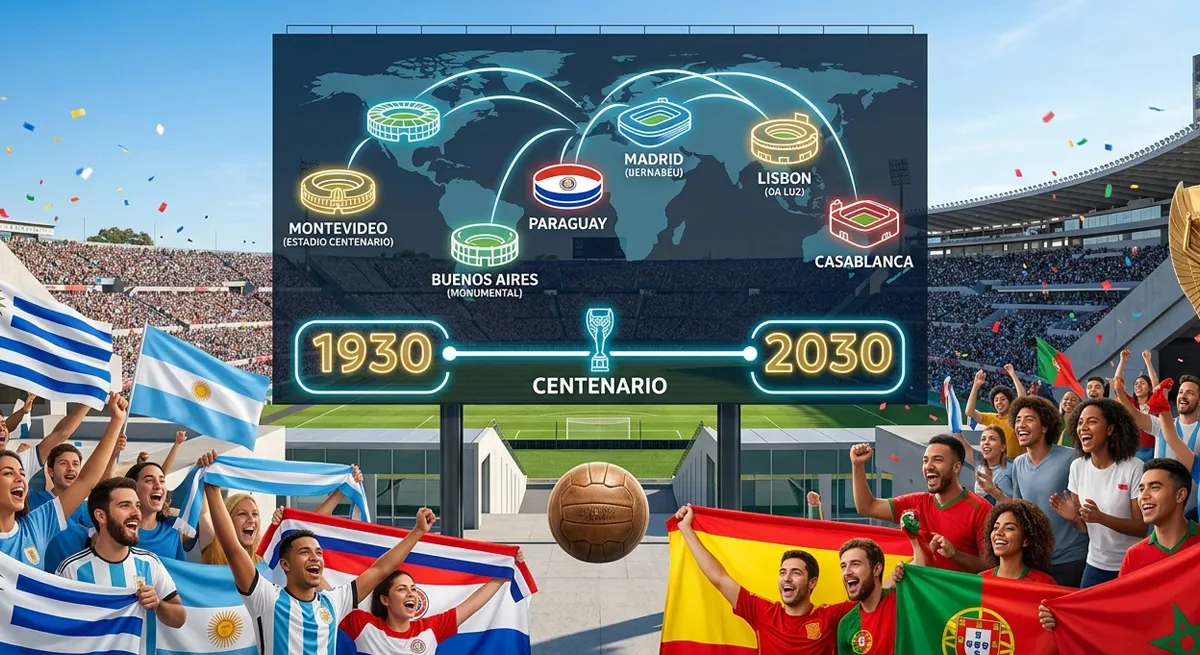
When the ball rolls in 2030, football will celebrate more than just another tournament. The 2030 World Cup will commemorate the centenary of the first world championship, that Uruguay 1930 that changed the history of the beautiful game forever. And it will do so in a way as ambitious as it is controversial: three continents, six countries, and a historical symbolism that promises football emotions from the first whistle.
What is known so far about this unique edition? Let's get straight to the point, with concrete facts and no beating around the bush.
The Origin: Uruguay 1930 and the Tribute in 2030
On July 30, 1930, Uruguay defeated Argentina 4-2 at the Estadio Centenario in Montevideo. That match not only gave the Charrúas their first world title but also planted the seed of the most-watched competition on the planet. One hundred years later, FIFA decided to return the tournament to its roots, but with an unexpected twist: instead of a single host, there will be six.
The Centenary Edition could not go unnoticed. The original bid by Uruguay, Argentina, and Paraguay was presented as a natural gesture: returning to the birthplace of the World Cup. However, football politics got involved. Spain, Portugal, and Morocco (a triple Euro-African alliance) also competed, but instead of a bid war, FIFA opted for something never seen before: merging both bids.
Where Will the 2030 World Cup Be Played?
This is where the fascinating and the complex begin. The 2030 World Cup will have three main hosts:
Spain (stadiums to be confirmed: Santiago Bernabéu, Camp Nou, Metropolitano, among others)
Portugal (Estádio da Luz, Estádio do Dragão)
Morocco (new stadiums in Casablanca, Rabat, Tangier)
But there's more. As a historical nod, the first three matches of the tournament will be played in South America:
Uruguay (Estadio Centenario in Montevideo)
Argentina (Estadio Monumental in Buenos Aires)
Paraguay (new stadium at the Triple Frontier, still under construction)
That is, the World Cup will begin on the continent that saw it born, with an inaugural match at the very Estadio Centenario. Then, the action will move to Europe and Africa for the rest of the group stage and knockout rounds.
Why Six Countries?
FIFA justified the decision as a global tribute: "The centenary of the World Cup deserves an event that unites the world." But critics point to logistical problems: transoceanic travel for teams and fans, time zone differences, and physical fatigue for players. Even so, the hype is real: seeing a World Cup that starts in Montevideo, passes through Buenos Aires, and ends in Madrid sounds like pure epic.
Tournament Format in 2030: More Teams?
There is still no official confirmation, but everything points to the 2030 World Cup maintaining the 48-team format introduced in 2026. The group stage would have 16 groups of three teams (as in the next World Cup in North America) or perhaps groups of four if FIFA reconsiders. The total number of matches would be 104, with 16 teams advancing to the round of 16.
What is certain: the centenary will bring calendar changes. With six venues on three continents, matches will be scheduled in time blocks to maximize global audiences. Imagine: a match at 10 a.m. in Buenos Aires, another at 3 p.m. in Madrid, and a nightcap in Casablanca. The party will be continuous.
Key Dates: Summer 2030
The tournament will take place between June and July 2030, with the final scheduled for Sunday, July 21 or 28. The exact date depends on local league calendars, but FIFA has already reserved the usual window. Uruguay, as the symbolic host of the opening match, could kick things off on July 8 or 9, 2030 — exactly 100 years after the first final. Coincidence? No, it's pure intention.
What About Qualification?
Each of the six hosts is guaranteed an automatic spot. That means Uruguay, Argentina, Paraguay, Spain, Portugal, and Morocco will be in the draw without needing to play qualifiers. For the rest, qualifying will begin in 2028 (in South America, Europe, Africa, Asia, and Oceania). CONCACAF will have its own process, but without any host in that region.
One curious detail: with three confederations involved (CONMEBOL, UEFA, and CAF), FIFA will need to adjust the slot allocations. It is expected that South America will receive at least 7 direct spots (counting the three hosts), Europe 16, Africa 9, and so on.
Infrastructure and Legacy: Are We Ready?
Spain already has top-level stadiums, but they will need to be renovated to 2030 FIFA standards. Portugal also has modern infrastructure. Morocco, on the other hand, is in a full sprint: it will build new stadiums in Tangier and Casablanca, in addition to modernizing the one in Rabat. Paraguay will build a stadium at the Triple Frontier (city of Presidente Franco), while Uruguay and Argentina only need minor tweaks at the Centenario and Monumental.
The estimated budget exceeds €2.5 billion, split among the six countries. FIFA has already announced that broadcast contracts will be the most expensive in history.
What Remains Unknown
Group draw: How will crazy travel be avoided? It is speculated that South American teams will sweat through the group stage on their continent before crossing the Atlantic.
Final: Will it be played at the Bernabéu, Camp Nou, or the new stadium in Morocco? Madrid sounds strong.
Mascot and anthem: The centenary will deserve a special design. FIFA will launch a global competition in 2027.
Conclusion: An Edition for the History Books
The 2030 World Cup is not just a tournament; it's a journey through time. From the Estadio Centenario in Montevideo to the modern European and African colossi, the ball will unite generations. Yes, there will be logistical complaints, but when the Uruguay national team steps onto the same field where their footballing great-grandfathers lifted the first trophy, you'll get goosebumps.