15 Curious Facts About the 2026 World Cup That Break History
The 2026 World Cup will not be just another tournament: it will be the first to break all the unwritten rules of football. For the first time in 96 years, the World Cup will be played in three countries simultaneously, with 48 teams and a format that challenges tradition. Here we share 15 curious facts that will make you see this event differently, connecting each figure to the past to understand why this World Cup will mark a before and after.
We start with facts that few know yet.
1. The Longest World Cup in History
With (compared to 64 in Qatar 2022), the 2026 World Cup will be the longest: from the first match to the final. It surpasses the record of 32 days from France 1998. This means players will experience an unprecedented , with minimal rest between phases.
This is the first time three nations host a World Cup. Mexico has already done so in 1970 and 1986; the USA in 1994; Canada is an absolute debutant. The curious fact: Canada has never qualified for a men's World Cup (the women's team has). We'll see if home advantage gives them a boost.
3. The Craziest Format Ever Seen
With 48 teams, the tournament will have 12 groups of 4 teams. The top two from each group advance to the round of 16, as well as the 8 best third-placed teams. This means a team could advance with just one win or even two draws, something that hasn't happened since 1982.
How many matches will a potential champion play?
If they win all matches, they will play 8 matches (3 group, 1 round of 16, 1 quarterfinal, 1 semifinal, 1 final). This is the same number as in 1982-1994, but with more possible opponents.
4. Mexico's Return… and a "Three-Time" Record
Mexico will become the first country to host three World Cups (1970, 1986, 2026). It surpasses Italy (1934, 1990) and France (1938, 1998). Additionally, the Estadio Azteca will be the first venue to host three different World Cup editions (1970, 1986, 2026). Pelé and Maradona were crowned there.
5. 16 Venues Spread Across 3 Countries
11 in the USA (including MetLife Stadium in New Jersey, which will host the final).
3 in Mexico (Azteca, Akron in Guadalajara, BBVA in Monterrey).
2 in Canada (BC Place in Vancouver, BMO Field in Toronto).
This is the largest number of stadiums since 2002 (South Korea/Japan, with 20). But the real rarity: the venues are in 9 different time zones, which will force matches to be scheduled at very different times for the global audience.
6. The Opening Match… at the Azteca?
Although not yet official, everything points to the opening match being played at the Estadio Azteca (Mexico City), paying homage to history. It would be the third time the Azteca opens a World Cup (1970 and 1986). An emotional detail: Mexico will host the first match, but the final will be in New Jersey.
7. The Most Complex Draw in History
The 2026 World Cup draw will have to meet unprecedented geopolitical restrictions: no group can have two teams from the same confederation (except UEFA, which can have up to two). Also, the three hosts (Mexico, USA, Canada) will be seeded, something that has never happened with three teams from the same continent.
8. The Largest Number of Debuting Teams
At least 8 teams are expected to make their absolute World Cup debut (e.g., Canada, or possible qualifiers from Oceania and CONCACAF). The current record is from 1930 with 13 debutants, but since 1950 no tournament has had so many teams without World Cup experience.
9. The Most "Modern" (and Controversial) Mascot
Not officially revealed yet, but rumors point to a digital interactive character (like a hologram or avatar) that will accompany fans on social media and in stadiums. It would be the first non-physical mascot in World Cup history, breaking the tradition of dolls (like the Lion in 1970 or Tip in 1998).
10. The Official Ball… with Artificial Intelligence?
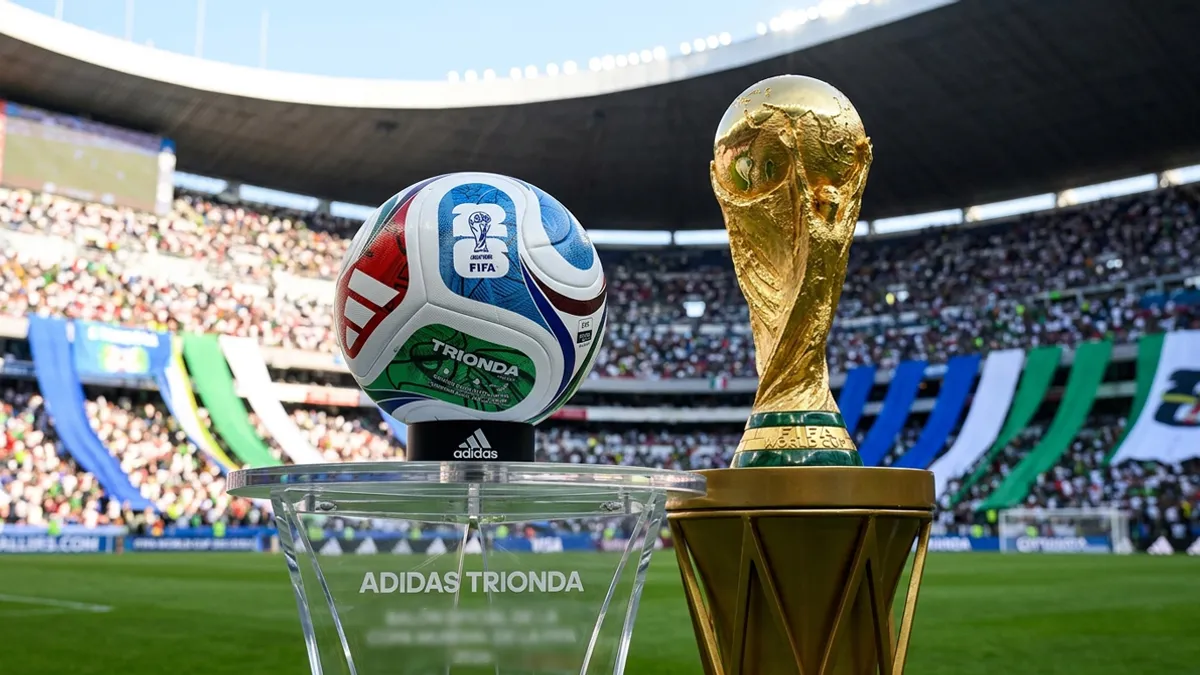
Adidas is already preparing a ball with an internal chip that will measure trajectory, speed, and even shot power in real time. Similar to the Al Rihla in Qatar 2022, but with more advanced sensors to help VAR detect millimeter offsides. A technological leap that will change refereeing.
11. The Northernmost and Southernmost Matches in History
BC Place in Vancouver (Canada) will be the northernmost stadium in a World Cup (latitude 49.28° N), surpassing Moscow 2018 (55.75° N, but Luzhniki Stadium is at 55.7°). Meanwhile, BBVA Stadium in Monterrey (Mexico, 25.67° N) will be one of the southernmost venues of the tournament. The climate contrast will be brutal: from Canadian cold in June to the humid heat of Mexico City.
12. The Final Will Be Played at the Same Venue as 1994
MetLife Stadium in East Rutherford (New Jersey) will host the final on July 19, 2026. That same state (New Jersey) hosted the 1994 final at the Rose Bowl (Pasadena, California). But the curious fact: MetLife is the only stadium that has never hosted a World Cup final and now will, less than 50 kilometers from the Statue of Liberty.
13. VAR Will Be Used in All Matches (Including Group Stage)
Although it seems obvious, it's not. In 2018, VAR was only used from the quarterfinals. In 2022, it was used in all matches. But for 2026, FIFA has announced VAR with remote assistants from a central hub in Zurich to speed up decisions. Additionally, for the first time, semi-automatic offside will be tested in three different countries.
14. The Largest Broadcast in History
The global audience is expected to exceed 6 billion people (in 2022 it was 5 billion). It will be the most-watched sporting event in history, thanks to time zones allowing prime-time slots in America, Europe, and Asia. A match at 9:00 PM in New York equals 3:00 AM in Madrid… but FIFA is already negotiating morning times for Europe.
15. For the First Time, an Oceania Team Could Debut
The Oceania Football Confederation (OFC) will have a direct spot (until now, only a playoff). This means New Zealand or a debutant like the Solomon Islands (which never qualified) could be in the World Cup. It would be the first time Oceania has its own representative since Australia (moved to AFC in 2006).
A World Cup That Breaks Molds
The 2026 World Cup will not only be the largest in numbers: it will be a historic experiment that tests logistics, player endurance, and fan passion. Three countries, 48 teams, 104 matches, and a trophy that will travel across North America. Will FIFA manage to maintain the essence of football under such magnitude? We'll find out soon.
Which of these facts surprised you the most? Leave it in the comments and share this article with other football fans.