From 'Copper Bullets' to 'Socceroos': Weirdest National Team Nicknames
June 16, 2026 7 min readPrediPick
What do a kangaroo, a copper bullet, and a desert fox have in common? They are all official nicknames of national football teams. Behind each moniker lies a story—of culture, identity, pride, and sometimes tragedy. In this article, we explore the most curious, original, and surprising nicknames in world football, those that go far beyond the typical "the Reds" or "the Blue and White."
Why Do Nicknames Matter in Football?
Before diving in, it's worth asking: what purpose does a nickname serve in football?
The answer goes beyond aesthetics. A is part of a . It condenses history, geography, fauna, colors, and even the character of its people into a single word or phrase. For fans, their national team's nickname is as sacred as the anthem or the jersey.
And at the World Cup, where 48 nations with radically different cultures coexist, these nicknames become cultural ambassadors: the first window into a country's soul.
The Strangest (and Most Fascinating) Nicknames in the World
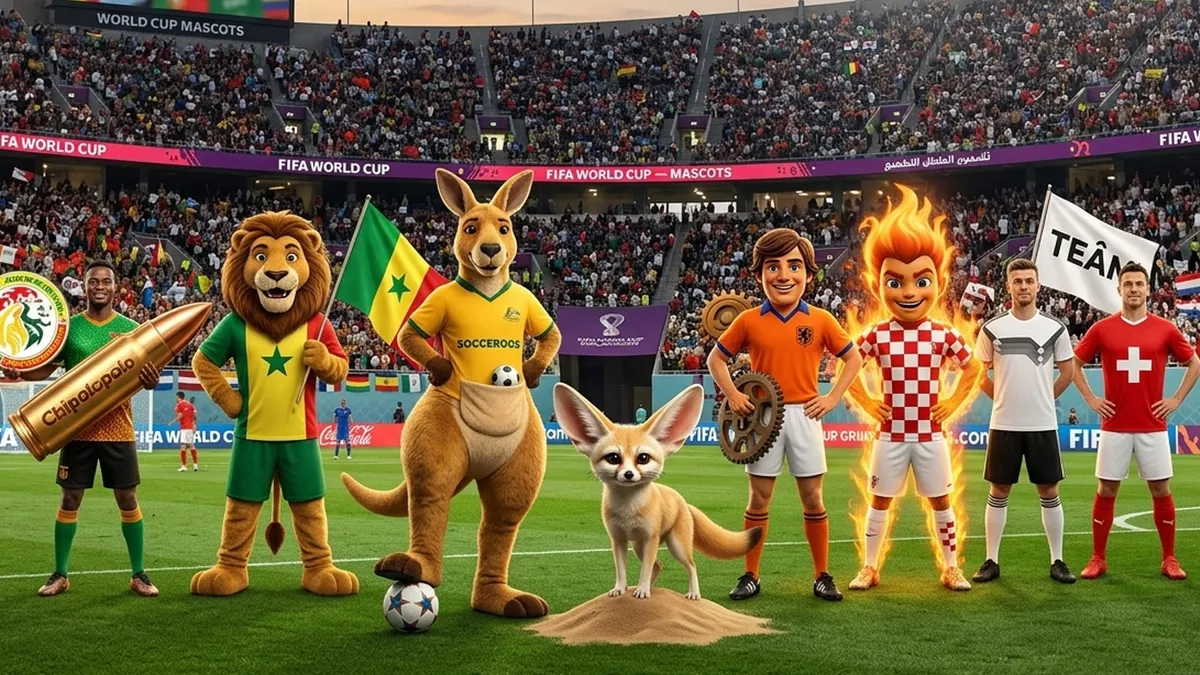
The Socceroos — Australia
If any nickname deserves the prize for originality, it is Australia's: the Socceroos.
The word is a perfect fusion of "soccer" and "kangaroos," the most iconic animal of Oceania. The result is literally "Soccer Kangaroos."
The curious thing is that the nickname didn't emerge spontaneously or popularly. It was born in the 1970s as a commercial nickname to differentiate the team in a country where rugby and Australian rules football completely dominated the sports scene. It was, in essence, a marketing strategy to give football its own identity in Australia.
Today, the Socceroos are one of the most recognized nicknames in the world. Proof that sometimes the strangest thing ends up being the most memorable.
The Chipolopolo — Zambia
This is the nickname with the most emotionally charged and symbolic story in all of African football.
"Chipolopolo" means "the copper bullets" in the Bemba language, Zambia's local tongue. The name directly refers to copper, the country's most abundant resource and main economic wealth.
But behind the nickname lies a devastating story. In 1993, just as the team was on the verge of qualifying for the 1994 World Cup in the United States, the plane carrying the squad crashed off the coast of Gabon, and all 25 people on board lost their lives.
What happened next is one of the most incredible stories in sports. Zambia rebuilt its national team from scratch, and at the 2012 Africa Cup of Nations, the Chipolopolo became champions—in Gabon, the very place where the plane had fallen, just a few kilometers from the crash site.
A nickname that began as a tribute to the country's industry ended up becoming a symbol of resilience and redemption.
The Fennecs — Algeria
Algeria has several nicknames—"The Desert Warriors," "The Greens"—but the most original is undoubtedly "The Fennecs."
What is a fennec? The fennec fox is a small Sahara desert fox, known for its endurance and agility in extreme conditions. It became a national symbol, and from the 1970s onward, the national team also adopted it.
It's a nickname that baffles those unfamiliar with the animal: a fox with huge ears, weighing barely 1.5 kg, representing one of Africa's strongest teams. But therein lies the metaphor: speed, intelligence, and survival in the desert.
The Lions of Teranga — Senegal
Senegal's nickname is perhaps the most poetic and culturally profound in all of world football.
Senegal is called "The Lions of Teranga," a moniker with deep cultural significance. While lions symbolize bravery and strength, the word Teranga represents hospitality, respect, and fraternity.
"Teranga" is not just a word; it is a philosophical concept deeply rooted in Senegalese culture, describing the sacred duty to welcome and care for others. A football team that carries in its name not only the ferocity of the lion but also the value of welcoming foreigners—that is unique in the world of sports.
Die Mannschaft — Germany
Germany could have chosen any imposing nickname. And it chose... "The Team."
Yes, literally. Die Mannschaft means "The Team" in German, and it became popular during the 2006 World Cup as an international brand for the national side.
Strange? It depends on your perspective. For Germans, the simplicity of the name is a statement of principle: the individual doesn't matter; the collective is everything. Curiously, it is also the nickname of Austria, whose team is directly translated as "Das Team" (The Team). Two neighboring countries, the same concept, the same philosophy.
The Clockwork Orange — Netherlands
This is the most cinematic nickname in world football, and also the most steeped in tactical history.
'The Clockwork Orange' refers to the total, attacking football that the Netherlands displayed during the 1970s, with stars like Cruyff, Krol, and Neeskens. Additionally, the color orange refers to the House of Orange-Nassau, which rules the Netherlands.
The name borrows the title of Stanley Kubrick's famous 1971 film to describe a relentless, coordinated, and brilliant football machine. The combination of real identity, color, and playing philosophy into a single nickname—hard to beat.
La Nati — Switzerland
If Germany chose "The Team," Switzerland went even simpler: it simply calls itself "La Nati."
The nickname comes from an abbreviation of the German term for "national team." While perfectly normal for the Swiss, it often sounds strange abroad because it doesn't refer to animals, colors, or patriotic symbols.
In a world where teams compete for the most epic nicknames, Switzerland opted for total practicality. "La Nati" is almost an anti-nickname: no adjectives, no metaphors, no pretensions. And yet, it works.
The Vatreni — Croatia
Croatia has one of the most literarily interesting nicknames in European football: "The Vatreni," which in Croatian means "The Fiery Ones" or "Those Who Burn."
Croatian writer Josip Prudeus first coined the term 'Vatreni' in 1996 in the lyrics of the football anthem '11 Vatrenih' (11 Fiery Ones). The nickname caught on just as Croatia debuted as an independent nation at Euro 1996 and reached third place at the 1998 World Cup in France.
A nickname born from literature, adopted by the people, and consecrated in stadiums. Few have such a noble origin.
The Pattern Behind the Nicknames
Analyzing all these nicknames reveals some clear patterns:
Africa tends to name their teams after local fauna: lions, eagles, hornbills, cranes. Nature as a symbol of power.
Europe mixes colors, history, and philosophy: Red Devils, Clockwork Orange, teams without adjectives.
Oceania and the Caribbean play with geographical identity and linguistic creativity: soccer kangaroos, spice boys, rainbow warriors.
Asia draws on historical or martial references: samurai, Taeguk warriors, Princes of Persia.
Each continent has its own language for naming its football warriors.
Did You Know...?
The longest and most descriptive nickname belongs to Djibouti: the small African nation calls itself "The Ribereños of the Red Sea" (or "The Shoremen of the Red Sea"). A geographical description so precise that it's hardly a nickname—it's almost a mailing address.
Grenada is "The Spice Boys": Grenada is known as the spice isle, and its national team proudly wears that name. A nickname that literally smells of pepper and cinnamon.
Croatia is also called "Kockasti": besides "The Vatreni," Kockasti refers to the red-and-white jerseys of Croatia and the traditional checkerboard pattern that fills the national coat of arms. A team with two completely different nicknames, each with its own story.
National team nicknames are much more than labels: they are capsules of national identity compressed into one or two words. Every time you hear "Chipolopolo" or "Socceroos," you are also hearing history, geography, and culture. And in a tournament like the World Cup, where 48 nations share the same pitch, this diversity of names is, in itself, a celebration.