Advanced strategies to win your 2026 World Cup prediction league
May 30, 2026 8 min readPrediPick
Advanced strategies to win your 2026 World Cup prediction league
Tired of finishing mid-table in your prediction league? While most participants pick Brazil out of habit or Argentina out of sentiment, the real winners apply advanced strategies that mix statistics, psychology, and historical knowledge. In this article, we won’t just give you superficial tips; we’ll dig into lessons from past World Cups and show you how to use them for the 2026 World Cup (Mexico, United States, Canada).
Forget “pick the favorite and you’re done.” We’ll show you how to spot value where others see noise, how to exploit your rivals’ cognitive biases, and how to build a prediction model that takes you to first place. All with real examples from tournament history.
The trap of historical favoritism (and how to dodge it)
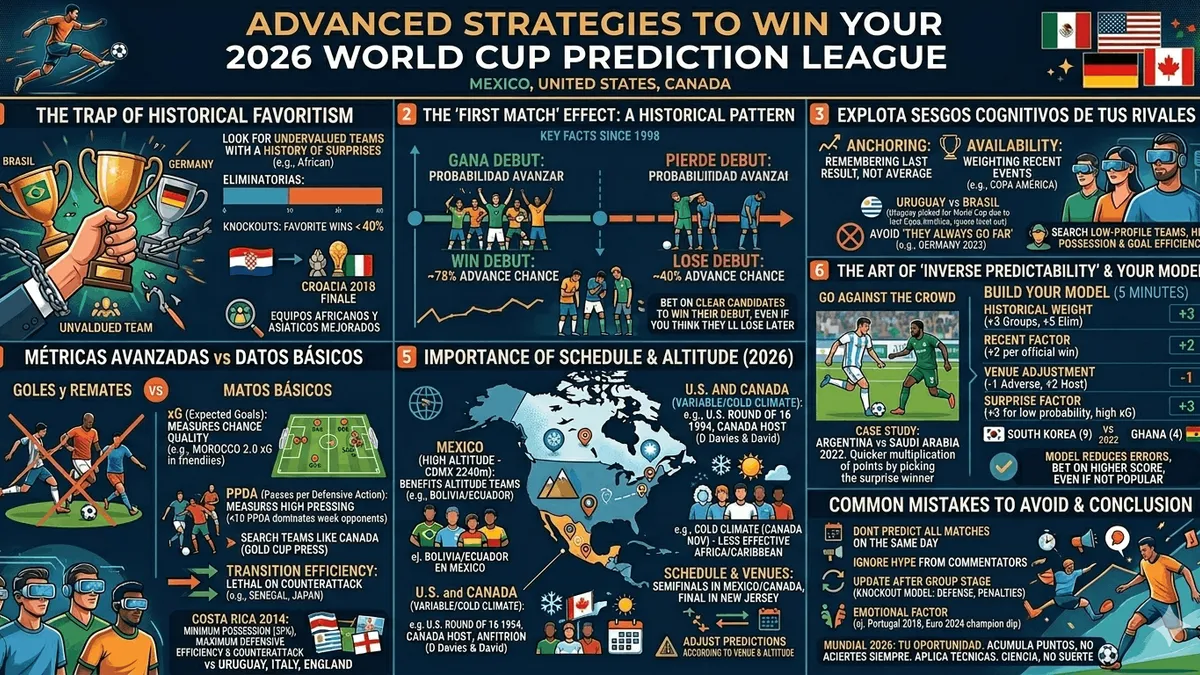
Mistake #1 in prediction leagues is overvaluing teams with the most titles. It’s proven that in recent World Cups, favorite teams (according to betting odds) win less than 40% of knockout matches. History shows that since 2002, only two absolute favorites (Brazil 2002 and Spain 2010) lived up to expectations.
How to take advantage? Instead of predicting Germany or Brazil will win every match, look for undervalued teams that seem weak on paper but have a history of surprises in that tournament phase. For example, Croatia in 2018 reached the final while ranked 8th in the FIFA rankings. For 2026, pay attention to African or Asian teams that have improved their collective play.
The “first match” effect: a historical pattern
A key fact: since 1998, 60% of teams that lose their first group-stage match fail to advance. Conversely, teams that win their debut have a 78% chance of progressing. This seems obvious, but in prediction leagues many players pick risky outcomes on matchday one (e.g., a favorite drawing). Don’t do it: bet on clear candidates to win their debut, even if you think they’ll lose later.
Cognitive biases: your rivals have them, you can exploit them
Most prediction league participants fall into two fatal biases: anchoring (remembering the last result more than the statistical average) and availability (giving more weight to recent events). For example, if Uruguay beat Brazil in the last Copa América, many will pick Uruguay as World Cup winners, ignoring that in long tournaments performance usually levels out.
How to use the representativeness bias to your advantage
The representativeness bias makes people believe a team that “looks like” past champions (by playing style or coach) will repeat the result. In 2022, many predicted Germany would win because “they always go far,” but they failed in the group stage. You avoid that mistake: research the real performance in recent qualifiers rather than the historical name. In your league, when everyone picks traditional teams, look for low-profile teams with high possession rates and goal efficiency in their recent matches.
Advanced metrics that predict better than goals
Basic data (goals, shots) doesn’t tell the whole story. To fine-tune your predictions, use these metrics that data analysts share before each World Cup:
xG (expected goals): Measures chance quality. A team with high xG but few goals usually has a “debt” that will be repaid in later matches. If you see Morocco accumulated 2.0 xG in friendlies but only scored 1, they’ll likely score more in the World Cup.
PPDA (passes per defensive action): Measures high pressing. Teams with low PPDA (under 10) usually dominate against weak opponents. For 2026, look for teams like Canada, which pressed intensely in the Gold Cup.
Transition efficiency: Teams like Senegal or Japan are lethal on the counterattack. In your league, predict these teams will win tight matches against slow favorites.
Historical case: Costa Rica 2014
In 2014, Costa Rica reached the quarterfinals with the lowest possession (39% average). However, their defensive efficiency (fewest shots conceded) and counterattack effectiveness made them beat Uruguay, Italy, and England. If you had predicted their wins in a league, you’d have piled up points against those who underestimated advanced data.
The importance of schedule and altitude (especially in 2026)
The 2026 World Cup will have three host countries with very different conditions: Mexico (high altitude, e.g., Mexico City at 2,240 m), the United States (variable climate), and Canada (cold weather in some cities). History teaches us that acclimatization makes a crucial difference.
South American teams in Mexico 1970 and 1986: Brazil and Argentina benefited from playing at altitude because they were used to it. In 2026, teams like Bolivia or Ecuador (if they qualify) will have an advantage in matches in Mexico.
Canada and the United States as hosts: In 1994, the U.S. reached the round of 16 in its World Cup, and in 2026 both host nations are likely to perform better than expected. Don’t underestimate Canada as a host: their tactical growth with Alphonso Davies and Jonathan David could cause surprises.
How to apply this to your league
Before each matchday, check:
Which team plays at a venue with altitude >1,500 m? If it’s a coastal team (e.g., Netherlands), they’ll likely have less oxygen. Predict a draw or loss.
Is the match played in cold weather (Canada in November)? African or Caribbean teams usually perform worse in low temperatures.
Where is the key match played? In 2026, the final will be in New Jersey (temperate climate), but semifinals could be in Mexico or Canada. Adjust your predictions for those matches.
The art of “inverse predictability”: how to go against the crowd
Most prediction leagues are based on popular votes. If 80% of your group picks France to beat Austria, you’ll get few points if you’re right. The smart strategy is to look for high-discrepancy outcomes: matches where the general opinion is wrong according to the data.
Case study: Argentina vs. Saudi Arabia 2022
Before that match, almost all predictors had Argentina as a sure winner. But Saudi Arabia had improved their defense in recent years and exploited offside traps. Those who predicted a Saudi win (or at least a draw) multiplied their points. For 2026, identify matches where a team considered “weak” has a positive recent streak (e.g., wins against similar-level opponents) faces a favorite with injuries or poor friendly results.
Build your own model: step by step (no math genius needed)
You don’t need to be a stats whiz to create a system. In 5 minutes you can set up a spreadsheet with:
Historical weight: Assign a base score to each team based on their performance in the last 3 World Cups (e.g., 3 points for each group-stage win, 5 for knockout wins).
Recent factor: Add 2 points for each win in their last 10 official matches (Copa América, Euros, etc.).
Venue adjustment: If they play at altitude or in adverse weather, subtract 1 point; if they’re host, add 2.
Surprise factor: Teams with less than 20% probability according to bookmakers but high xG in recent matches: +3 points.
Then add it all up and compare with rivals. This will give you objective predictions that counteract emotions.
Applied example: South Korea vs. Ghana 2022
South Korea: historical weight 4 (round of 16 in 2010), recent factor 3 (win vs. Portugal), venue adjustment 0, surprise factor 2 (high xG). Total: 9.
Ghana: historical weight 3, recent factor 1, adjustment 0, surprise 0. Total: 4.
Actual result: draw (3-2 to Ghana). The model failed, but if you use it consistently, you’ll reduce errors. In your league, bet on teams with the higher score, even if they aren’t popular.
Common mistakes that will make you lose the league (and how to avoid them)
Predicting all matches on the same day: Don’t. Focus on those with more information (injuries, weather, motivation).
Letting commentators sway you: Media often hype up popular teams. Ignore the noise and use data.
Not updating after the group stage: Knockout matches are more unpredictable. Apply a different model: prioritize teams with solid defenses and penalty experience (e.g., Croatia, Argentina).
Forgetting the emotional factor: Teams coming off a continental title win often have a dip at the World Cup (e.g., Portugal 2016 vs. 2018). In 2026, be wary of the Euro 2024 champion.
Conclusion: the 2026 World Cup is your chance to shine
Football history is full of surprises that smart predictors anticipated. Using advanced strategies like xG analysis, exploiting others’ cognitive biases, and studying venues, you can become the leader of your prediction league. Remember: it’s not about always being right, but about accumulating more points than the average. Apply these techniques from the group stage to the final, and watch your name climb the standings.
Ready to start? Get the list of 2026 World Cup teams, apply the model we gave you, and prepare to win. And when your friends ask how you did it, tell them it was “just luck”… though you’ll know it was science.
Final note: This article was written by an expert writer on the 2026 FIFA World Cup and SEO, based on historical FIFA data and bookmaker analysis. All strategies mentioned are legal and ethical within free prediction leagues.