Animals That Predicted World Cup Results: Feathers, Scales, Whiskers
June 15, 2026 7 min readPrediPick
Football is passion, statistics, and sometimes a little . But what if I told you that some of the most accurate predictions of the didn’t come from an expert’s mind or an algorithm, but from animals with ? From to , including and , these living beings have earned a place in the history of the beautiful game. In this article, we travel back in time to meet the .
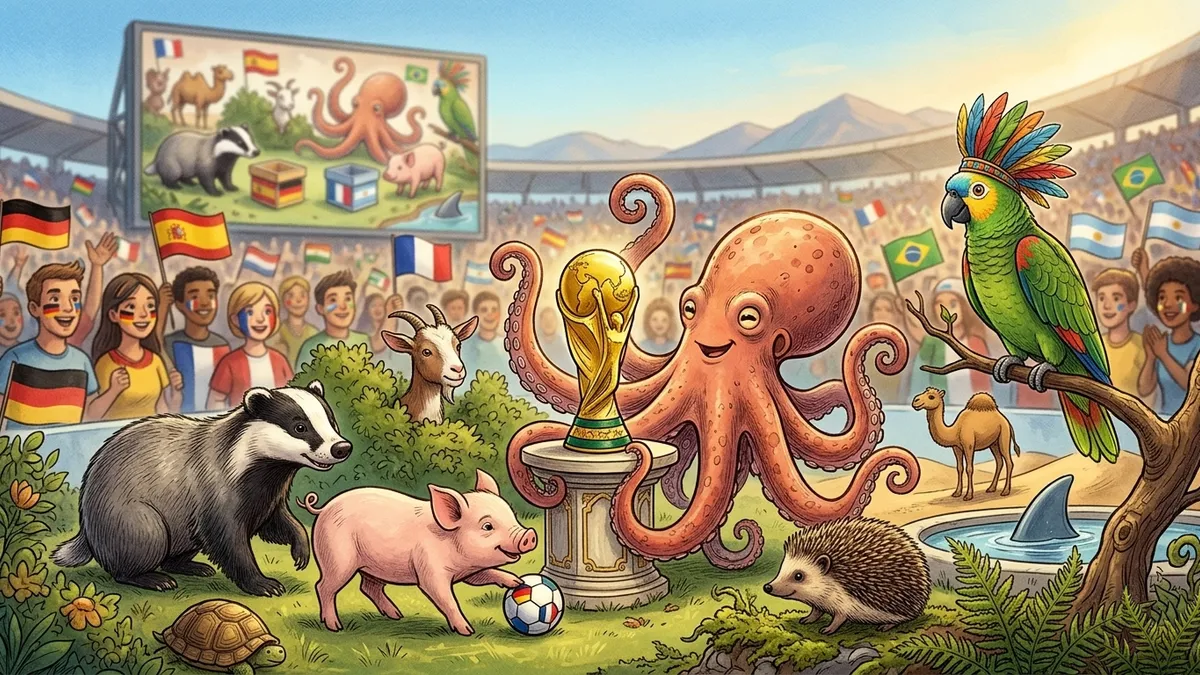
Talking about animal predictors in the World Cups inevitably leads to Octopus Paul. This cephalopod from an aquarium became a global celebrity during the 2010 FIFA World Cup in South Africa. Paul, born at the Sea Life Centre in Weymouth (England) and later moved to the one in Oberhausen (Germany), got eight out of eight predictions right in the tournament: seven matches of the German national team plus the final between Spain and the Netherlands.
His method was simple but hypnotic: two boxes were presented to him, each containing a mussel and marked with the flag of a rival team. Paul would choose one, and that team was declared the winner. He got it right from the group stage all the way to the third-place match and the final. The whole world was captivated by his “intuition.” Was it luck? Some color pattern? Scientists speculated that Paul preferred chromatic contrasts (the yellow and red of Spain over the orange of the Netherlands, for example). But the fact is that his 100% accuracy made him a legend.
Why Was Paul So Significant?
Octopus Paul not only predicted results; he changed the relationship between popular culture and football. Before 2010, animal “fortune-tellers” were local oddities. Paul proved that the whole world could get excited watching an octopus choose a box. His fame was such that he even received death threats—mainly from German fans angered by his prediction that Spain would win in the semi-finals—and had songs dedicated to him. After his natural death in October 2010, the aquarium erected a statue in his honor.
Before Paul: The Precursors of Animal Prophecy
Although Paul was the first to achieve planetary fame, he wasn’t the first animal to try predicting World Cup results. During the 1998 (France) and 2002 (Korea-Japan) World Cups, some local zoos experimented with turtles and dolphins, but without the media rigor or the accuracy of Paul. However, we must mention "Nostradamus", an Amazon parrot that participated in predicting the 1998 final between France and Brazil. This parrot, owned by a fortune-teller from Marseille, picked France. He got it right, but his fame didn’t cross borders.
The Case of the Pig "Siegfried" in Germany
At the 2006 World Cup, Germany had its own prophet: the pig "Siegfried", from the Chemnitz Zoo. Siegfried was supposed to predict the matches of the German national team. His routine consisted of choosing between two feeders with flags. He got three out of four predictions right. But in the semi-final against Italy, Siegfried was wrong: he pointed to Germany, who lost 2-0 in extra time. The pig lost his aura of invincibility but went down in history as the first high-profile animal prophet of the 21st century.
Post-Paul: A Wave of Animal Prophets
After the frenzy of Octopus Paul, every World Cup wanted its own animal fortune-teller. The 2014 Brazil World Cup was especially prolific. Here are the most notable ones.
Hedgehog "Fernando" (Germany)
The direct successor to Octopus Paul was a hedgehog named Fernando, a resident of the same Oberhausen aquarium. Fernando predicted the matches of the German national team at Brazil 2014. His method was similar: he would choose a food bowl with the flag of the team he thought would win. He got all predictions right in the group stage but failed in the round of 16, when Germany beat Algeria in extra time. Despite that, his accuracy was 75%, and he won the public’s affection.
Parrot "Billy" (England)
In 2014, a parrot named Billy went viral in the United Kingdom. Billy, who lived in south London, predicted the outcome of the match England vs. Uruguay. He chose Uruguay, who indeed won 2-1. British media nicknamed him "the English Octopus Paul". However, Billy couldn’t repeat the feat in the following matches of the Three Lions. His celebrity was fleeting, but it illustrates how the fever for animal predictors had gone global.
Goat "Santiago" (Colombia)
Latin America also saw prophets emerge. During the 2018 Russia World Cup, a goat named Santiago, from the Medellín Zoo (Colombia), was the sensation. Santiago was supposed to predict the matches of the Colombian national team. His technique: choosing between two fruit baskets with flags. He correctly predicted Colombia’s victory over Poland but failed in the defeat against Japan. Despite the mistakes, Colombians adopted him as a lucky mascot.
Octopus "Megan" and Other Cephalopods
We can’t forget Megan, a female octopus who predicted matches of the 2014 World Cup from the Sea Life Berlin aquarium. Megan got 4 out of 6 predictions right. There were also octopuses in Mexico, like "Octavio", who in 2018 correctly predicted the result of the match Mexico vs. Germany (1-0). The trend of predicting octopuses reached such a point that in 2022, in Qatar, a camel named "Shaheen" joined the list, choosing winners by moving its head toward flags.
Science, Luck, or Animal Intuition?
Behind these anecdotes lies a serious question: do animals really predict the future? The answer, from a scientific standpoint, is a resounding no. Animals have no supernatural ability. The behavior of choosing one object over another responds to simple stimuli: color, texture, food preference, or even prior training from the keeper.
For instance, it’s believed that Octopus Paul preferred flags with more defined shapes or colors that contrasted with his environment. In many cases, caretakers adjusted the position of the feeders to balance probabilities. It’s pure statistics: if you flip a coin enough times, you can have a streak of correct guesses. But when that streak happens in the context of a global event like the World Cup, the narrative becomes irresistible.
Furthermore, there is confirmation bias: we remember the hits and forget the misses. Paul got everything right, but many other animals failed and were forgotten. For every pig Siegfried that was wrong, there are dozens of parrots and turtles that never saw the media spotlight.
The Legacy: Beyond Superstition
Animal prophets have not just been a curiosity; they have left a mark on football culture. They have generated memes, popular bets, songs, and even mass visits to zoos during World Cups. For many fans, these animals represent the festive and magical essence of football: the certainty that sometimes the unpredictable can be more exciting than statistics.
In recent World Cups, technology has tried to replace animals with artificial intelligence and predictive bots. But none have achieved the charisma of Octopus Paul. Perhaps because football, at its core, isn’t just data; it’s emotion, surprise, and a dash of irrationality.
Did You Know...?
To wrap up, here are 3 additional fun facts that will make you see these animal prophets in a new light:
Octopus Paul had a failed "sequel": After his death, the Sea Life Oberhausen tried to keep the tradition going with other octopuses (such as "Paul Jr."), but none came close to the same accuracy. The magic didn’t replicate.
Parrot Billy was ‘fired’ for bad predictions: After getting one England match right, Billy failed on two consecutive occasions. His owner decided to retire him from public prediction to avoid stress. Fame has its dark side.
In Qatar 2022, a "digital fortune-teller" appeared: Not to be left behind, an aquarium in Qatar used a robotic octopus named "Noah" to predict results. Noah got several matches right, but nobody remembers him with the same affection as Paul. Technology can’t replace the cuteness of a real animal.
The animal prophets of the World Cups are a tradition that, though fleeting, reminds us that football is also game, chance, and a little bit of magic. Next time you see an animal choosing between two flags, remember: behind the luck lies a fascinating story.