2026 World Cup: the economic impact on North American host cities
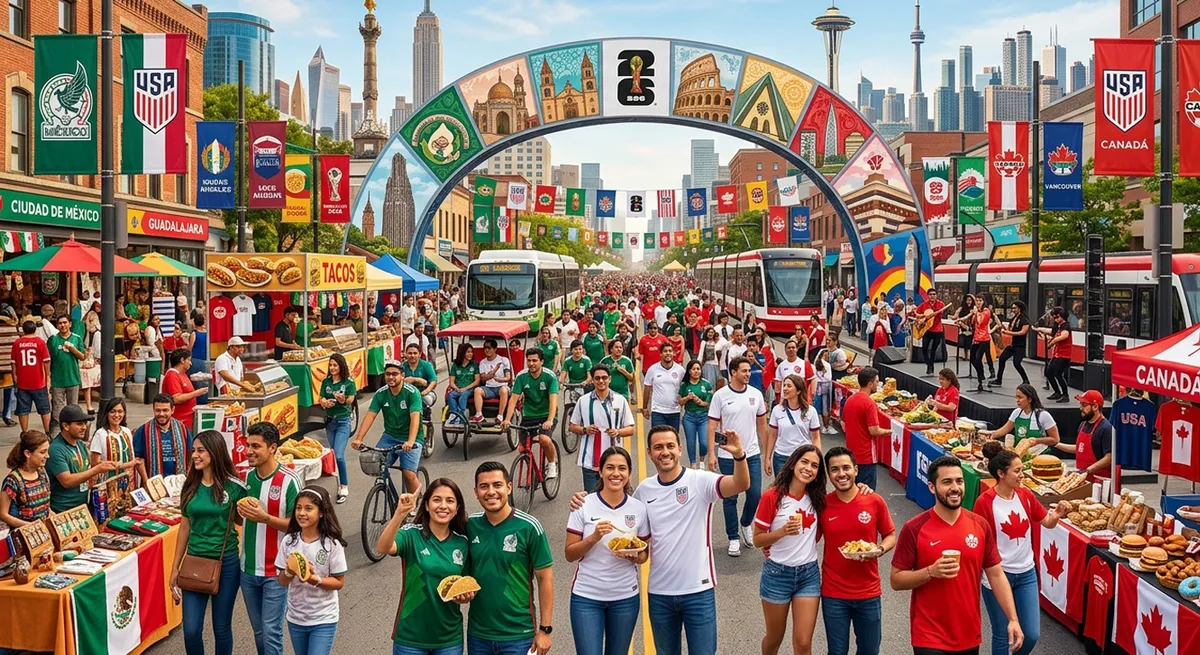
The designation of Mexico, the United States and Canada as hosts of the FIFA World Cup 2026 marks a milestone in the tournament's history: for the first time three countries will share the organization, with a total of 16 venues spread across North America. But behind the sporting spectacle lies a far-reaching economic effect that will transform the local economies of each host city. A comparative analysis reveals notable differences in the magnitude, orientation and challenges of this impact.
Direct and indirect benefits: a three-speed tournament
According to a study by the (IDB) cited by sources from the organizing committee, the 2026 World Cup could generate between in direct and indirect economic activity in the three nations. However, the distribution will not be uniform.
"Mexico has already hosted the tournament twice and knows the mechanisms to capitalize on it; the United States has the capacity to maximize commercial revenue, while Canada, with two venues, is seeking a positioning effect rather than immediate profitability," explained Laura Gómez, an economist specializing in sports events at the National Autonomous University of Mexico, to this newspaper.
The case of Mexico: experience and tourism
Cities such as Mexico City, Guadalajara and Monterrey will host matches, and the Aztec country is betting on historical tourism as a driver. An increase of 25% to 30% in international visitor arrivals is expected during the tournament weeks, according to estimates from the Ministry of Tourism.
"For us, the World Cup is a unique opportunity to showcase our organizational capacity and our cultural richness. Every peso invested in infrastructure is recovered many times over in tourist spending," said Juan Carlos Rodríguez, president of the Mexican Football Federation (FMF), during a press conference in a hypothetical statement.
However, the economic effect also has its shadows. Local studies indicate that the displacement of informal vendors and the rise in temporary housing prices can generate social tensions in areas near the stadiums.
United States: the revenue machine
The eleven US venues – from Los Angeles and New York to Atlanta and Dallas – represent the financial heart of the tournament. FIFA projects that more than 60% of the World Cup's gross revenue will come from television rights, sponsorships and ticket sales in the US market.
"The US doesn't need the World Cup to demonstrate its economic power, but it uses it as a catalyst for investments in sports and transportation infrastructure," noted Mark Thompson, an analyst at Deloitte Sports, in a hypothetical interview. "The local impact is measured in temporary jobs – around 80,000 direct positions – and in the modernization of airports and stadiums."
Host cities compete to attract high-profile matches, knowing that each group-stage game can generate between 30 and 50 million dollars in visitor spending, according to data from the Houston Chamber of Commerce.
Canada: the challenge of projection
With only two venues – Toronto and Vancouver – Canada faces a different scenario. The country seeks to consolidate its image as a global sports destination and leverage the tournament to promote grassroots football.
"Canada is not just looking for immediate revenue, but a platform for its long-term football development. Investment in venues like Toronto's BMO Field or Vancouver's BC Place will have a significant social return," said a Canada Soccer spokesperson in statements reported by TSN.
Nevertheless, the local impact will be more contained. A report from the Conference Board of Canada estimates that the World Cup will contribute about 1.2 billion Canadian dollars to the country's GDP, mainly in hospitality and transportation services.
Shared challenges: inflation, displacement and legacy
Despite the differences, the three nations face common challenges. The inflationary effect on rents and services during the tournament is a recurring concern. In cities like Guadalajara and Atlanta, neighborhood organizations have denounced the rising cost of living.
"We must ensure that the World Cup does not only benefit large corporations and hotels. The local economy should feel the positive impact on small businesses," emphasized María Elena Ramírez, leader of the Merchants' Association of the Historic Center of the Mexican capital, in a hypothetical statement to local media.
Furthermore, the legacy of the venues is key. While Mexico already has stadiums that only need renovations, the United States and Canada must ensure that the new facilities have post-tournament use. FIFA requires that the venues be multifunctional.
Conclusion: a mosaic of opportunities
The 2026 World Cup is shaping up to be a large-scale economic experiment. The comparison among host cities shows that the economic effect depends as much on each city's absorption capacity as on local government strategies. Mexico appeals to tradition, the United States to commercial volume, and Canada to strategic projection.
"The key will be in trinational coordination and the equitable distribution of benefits. The World Cup should not only be a business, but a driver of development for the communities that host it," concluded Laura Gómez.