South America's Tactical Revolution Towards 2026 World Cup
South America's Tactical Revolution Towards the 2026 World Cup
South America has been the birthplace of some of the most iconic football styles: Brazil's jogo bonito, Uruguay's garra, or Argentina's pause and touch. However, heading into the 2026 World Cup —to be held in Mexico, the United States, and Canada— the continent's national teams are undergoing a profound tactical transformation. Far from the improvisation of the past, modern structures that blend local identity with global trends now prevail. This article analyzes, with data and tactical focus, the path South American powerhouses are taking toward the next World Cup.
The Historical Legacy: From Improvisation to Tactical Order
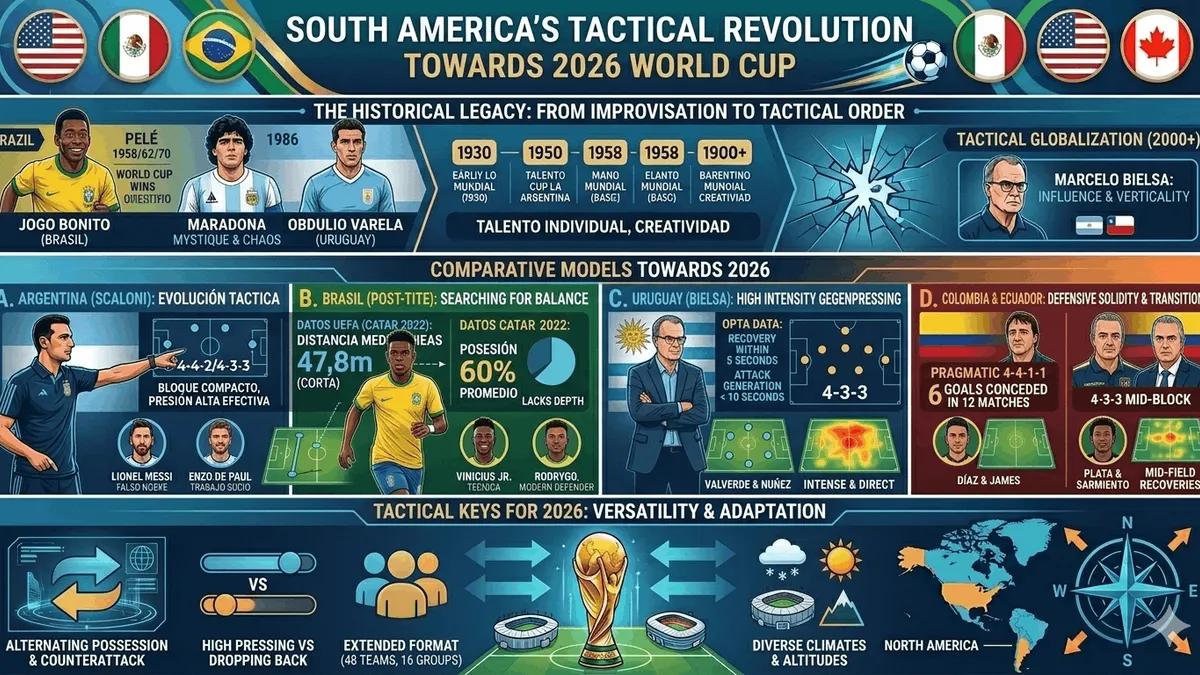
For decades, South American football was characterized by individual talent and creativity, often without a defined tactical foundation. Brazil won four of its five World Cups (1958, 1962, 1970, 1994) with teams that prioritized attack and technique over defensive organization. Argentina, meanwhile, combined Maradona’s mystique (1986) with more rigid schemes like César Luis Menotti's or Carlos Bilardo's pragmatism. Uruguay, with its grit and order, lifted the trophy in 1930 and 1950.
However, from the 2000s onward, tactical globalization —driven by European influence— forced South American teams to rethink their models. The arrival of coaches like Marcelo Bielsa (Chile, Argentina) and, more recently, Lionel Scaloni or Fernando Diniz, marked a turning point.
Argentina and Brazil: Two Contrasting Models Today
Argentina, world champions in 2022 under Scaloni, represents the best example of tactical evolution. Their defensive 4-3-3 adapted to a 4-4-2 in the offensive phase, with Lionel Messi as a false nine and a compact block pressing high in the opponent's half. According to UEFA data, the Albiceleste recorded an average distance of 47.8 meters between their defensive line and forward line during the Qatar World Cup, one of the shortest among champion teams, demonstrating effective high pressing.
Brazil, on the other hand, has maintained its offensive tradition but with tactical inconsistencies. In 2022, under Tite, the Canarinha displayed a 4-2-3-1 that prioritized possession (60% average) but lacked depth. For 2026, with a new coach —possibly a European or a South American trained abroad— Brazil seeks a balance between verticality and defensive solidity. Players like Vinícius Jr. and Rodrygo demand a system that exploits dribbling, but without neglecting the backline, a weakness exposed against Croatia in the penalty shootout.
The Present: High Pressing and Fast Transitions
The dominant trend in South America towards 2026 is organized high pressing and fast transitions. Teams that once relied on direct play now incorporate gegenpressing concepts. A clear example is Uruguay under Marcelo Bielsa. "El Loco" has implemented a high-intensity 4-3-3: La Celeste recovers the ball within five seconds after losing it (according to Opta) and generates attacks in under 10 seconds. With players like Federico Valverde and Darwin Núñez, Uruguay is shaping up to be one of the most intense teams in the continent.
Uruguay and Colombia: Defensive Solidity and Counterattack
Colombia, after the Reinaldo Rueda era, found in Néstor Lorenzo a pragmatic style: 4-4-1-1 with a double defensive pivot and quick wide outlets. The coffee growers conceded only 6 goals in 12 qualifying matches for 2026, a defensive solidity reminiscent of the 2014 team. The counterattack, led by Luis Díaz and James Rodríguez, is their main weapon.
On the other hand, Ecuador has managed to combine its youth academy with a tactical model of mid-block pressing and vertical transitions. Under Gustavo Alfaro (and later Félix Sánchez Bas), the Ecuadorians showed a 4-3-3 that prioritizes recovery in the opponent's half and direct attacks into space. Their speed on the wings (Gonzalo Plata, Jeremy Sarmiento) will be key in 2026.
Tactical Keys for 2026: Versatility and Adaptation
The 2026 World Cup will have an extended format (48 teams, 16 groups of three) and will be played in three countries with diverse climates and altitudes. For South American teams, tactical versatility will be decisive. Teams must alternate between possession and counterattack, between high pressing and dropping back, depending on the opponent and conditions.
The Influence of South American Coaches
A novel factor is the presence of local coaches who have absorbed European methodologies. Besides Scaloni and Bielsa, standout figures include Fernando Batista (Venezuela) with an attacking 4-2-3-1 that is leading La Vinotinto to its best historic moment, and Gustavo Costas (Paraguay), who revived the Guaraní grit with a defensive 4-4-2 and lethal counterattacks. Peru, under Jorge Fossati, seeks a balance between Ricardo Gareca's possession and a more vertical system.
According to a FIFA report, 70% of goals in the South American qualifiers for 2026 came from transition plays lasting less than 10 seconds. This data reveals that positional patience has given way to speed of execution.
Conclusion: The South America of the Future
South America is no longer just the continent of raw talent; it is a tactical laboratory that combines history with modernity. For the 2026 World Cup, the tactical revolution is underway: Argentina defends its title with a flexible model, Brazil seeks to reconcile art and order, Uruguay bets on intensity, and Colombia, Ecuador, and Venezuela represent a new wave of structured teams. The remaining teams (Chile, Paraguay, Peru, Bolivia) must adapt or be left behind. In a tournament that breaks molds, the ability to read the game and mutate on the pitch will be the difference between advancing and going home early.