2026 World Cup Predictions: How to Make Accurate Forecasts

The FIFA 2026 World Cup, which will be held in Mexico, the United States, and Canada, promises to be one of the most unpredictable tournaments in history. With an expanded format of 48 teams, new variables emerge that challenge even the most experienced analysts. But is it possible to make truly accurate 2026 World Cup predictions? The answer is yes, provided they are approached with a rigorous methodology and emotional biases are avoided. In this article, we explore the strategic keys to making accurate forecasts based on evidence, not gut feelings.
Key Factors for Accurate Predictions
To make accurate forecasts, looking at the FIFA ranking or the last Copa América is not enough. The analysis must integrate multiple dimensions: recent performance, squad depth, playing style, adaptation to the venues, and, above all, the tournament’s historical context. Below, we break down the fundamental pillars.
Historical Analysis and Trends
International football has recurring patterns. For example, since 1958, no team has won the World Cup outside its home continent except Brazil in 2002 (in Asia) and Spain in 2010 (in Africa). For 2026 (North America), American teams have a geographical advantage. Additionally, recent champions (France 2018, Argentina 2022) had an average age between 26 and 28, a relevant factor when evaluating young or veteran squads.
Another pattern: 70% of champions had reached at least the semifinals in the previous tournament. Thus, France (2022 finalist), Argentina (champion), and Croatia (third place) appear as natural candidates. However, the 48-team format introduces more matches, which could benefit deeper squads.
Evaluating Squads and Performance
Beyond the stars, success in a World Cup depends on collective balance. Teams like Brazil (with Vinícius Jr. and Rodrygo) or England (with Jude Bellingham and Harry Kane) have individual talent, but must demonstrate defensive solidity and tactical adaptation. An accurate forecast must consider injuries, suspensions, and accumulated fatigue after the European season.
Moreover, the new 48-team format means that second and third places in groups will have more chances to advance. This requires analyzing not only the favorites but also potential surprises like Morocco (2022 semifinalist), Uruguay (with a promising generational transition), or even host Canada.
Tournament Context and Venues
The venues in Mexico, the United States, and Canada introduce climatic and altitude variables. Estadio Azteca (Mexico City) sits at 2,240 meters above sea level, affecting physical performance. South American and Mexican teams are accustomed to it, but Europeans like Germany or the Netherlands could struggle. Additionally, the travel logistics between cities (from Vancouver to Mexico City is over 4,000 km) will require squad management that only the best-prepared coaching staff can handle well.
Data-Driven Methodology
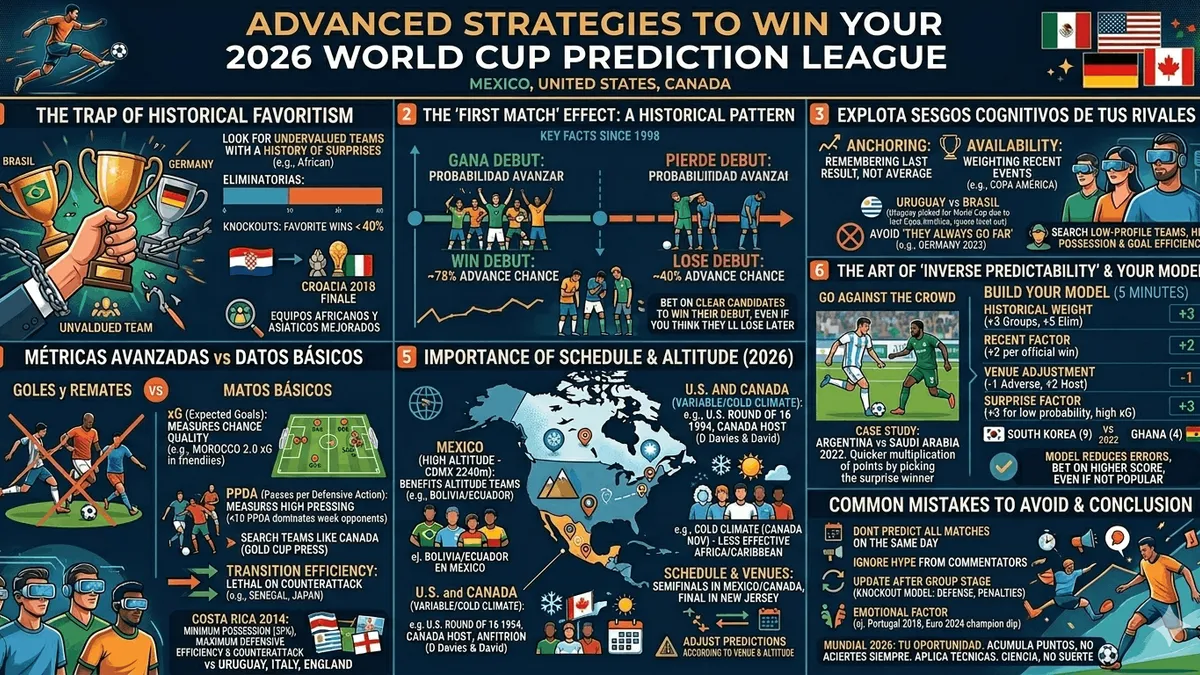
To make well-founded 2026 World Cup predictions, it is advisable to adopt a quantitative approach. Tools like Expected Goals (xG) and the Elo model (adjusted for national teams) offer a more objective view. For example, according to the November 2025 Elo Rating, the five best-rated teams are Brazil, Argentina, France, England, and Spain. However, historical performance in World Cups adds an extra factor: Argentina has a 12% title-winning rate when participating as defending champions; France has 20%.
A recommended methodology is to assign weights to different indicators:
- Performance in qualifiers and recent tournaments (40%)
- Squad depth and injuries (25%)
- Contextual factors (venues, climate, travel) (20%)
- History in previous World Cups (15%)
This model does not predict with certainty, but it reduces the margin of error compared to purely intuitive forecasts.
Common Mistakes When Making Predictions
Even the most informed fans fall into biases. The most frequent are:
- Recency bias: Overvaluing the team that won the last Copa América or European Championship. For example, Argentina could not defend its title in 2022 (it won the 2021 Copa América but then lost the 2022 World Cup opener against Saudi Arabia). Football changes quickly.
- Media favoritism bias: Teams like Brazil always appear in every pool, but they haven't reached a final since 2002. Pressure and lack of tactical balance have been their Achilles' heels.
- Ignoring home-field advantage: Host teams (USA, Mexico, Canada) have a statistical edge: since 1930, three hosts have won the tournament (Uruguay, Italy, Argentina) and many have reached semifinals. , which hosted in 1970 and 1986 (quarterfinals both times), should not be dismissed.
Conclusion: Prediction as a Process, Not a Destination
Making accurate forecasts for the 2026 World Cup is not a matter of luck, but of applying strategic analysis that combines history, data, context, and a touch of flexibility. No prediction is infallible, but a well-structured methodology allows identifying the strongest candidates and the most likely surprises.
In a tournament that breaks all molds (48 teams, three host nations, new group format), the key is to constantly update forecasts based on injury developments, physical form, and group stage results. Thus, when the final whistle blows on July 19, 2026, those who have followed a rigorous process can proudly say that their prediction was not a hunch, but the result of intelligent work.