Tiki-Taka Spain 2010: The philosophy that conquered the World Cup
June 26, 2026 4 min readPrediPick
Tiki-Taka Spain 2010: The philosophy that conquered the World Cup
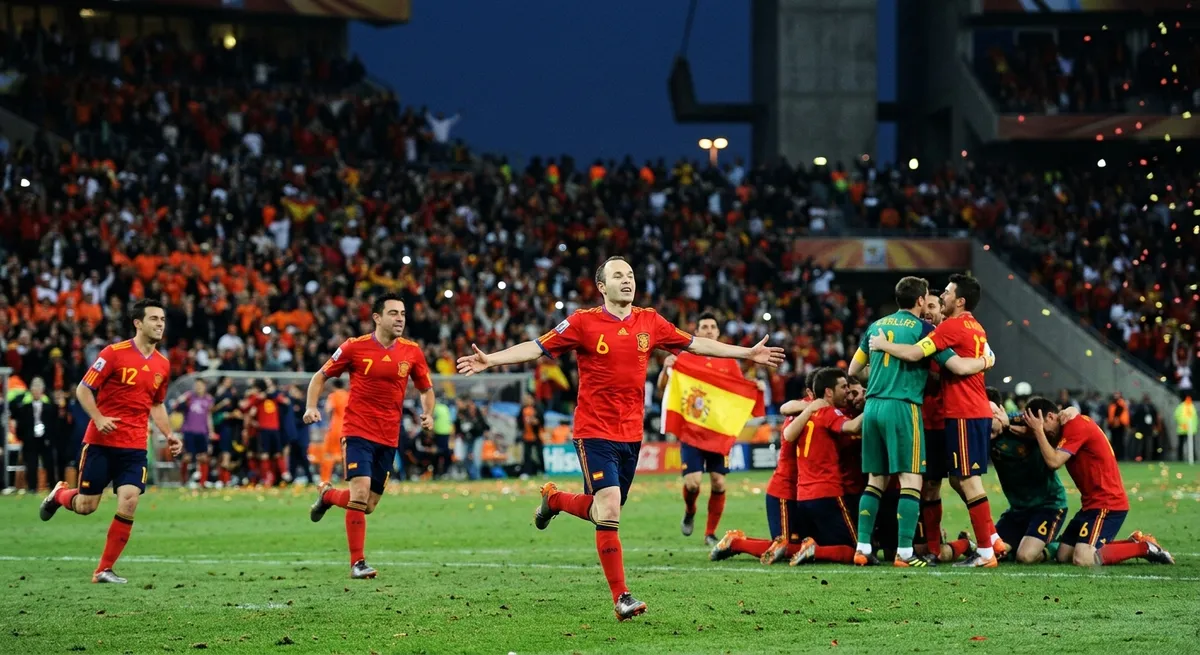
If there is one team that redefined the concept of "playing well" in football, it was the Spanish National Team at the 2010 World Cup in South Africa. They didn't just lift the trophy; they did so by imposing an idea, a style: tiki-taka. That Spain team wasn't simply champion; it was a tactical revolution that, 16 years later, remains the mirror in which many want to see themselves.
Today, while the Group Stage of the 2026 World Cup heats up in the United States, Mexico, and Canada, it's worth looking back and understanding how a group of talents led by turned possession into a lethal weapon. Was it luck? Was it deserved? Let's analyze the perfect machine.
It wasn't just passing for the sake of passing. Tiki-taka is a game philosophy based on ball possession as both a defensive and offensive tool. Spain 2010 took it to the extreme: if you have the ball, the opponent cannot attack. Simple, but diabolically effective.
The tactical pillars of the champion
Suffocating possession: Keeping the ball wasn't a luxury; it was a necessity. Spain averaged over 60% possession in every match. It exhausted the opponent mentally and physically.
Pressure after loss: As soon as they lost the ball, 3-4 players generated instant pressure to win it back within 5 seconds. This prevented counterattacks.
Constant mobility: Xavi Hernández, Andrés Iniesta, and Xabi Alonso moved in impossible triangles for the opponent. There was no fixed attacking midfielder; everyone rotated.
Why did it work in South Africa?
Because the Spanish team had the patience of a predator. They could have 70% possession without creating clear chances, but in the 80th minute, when the opponent could barely breathe, the strike would come. That's how the 1-0 wins in the knockout stage were born.
The unsung heroes and the unbeatable records
Beyond the famous goal by Iniesta in the final, this team built a dynasty on nearly perfect defensive foundations.
Records that still amaze
Fewest goals conceded: Spain received only 2 goals in the entire tournament (1 from Switzerland in the group stage and 1 from Chile). In the knockout rounds: 0 goals against.
Unbeaten goal: Iker Casillas had a legendary performance, especially in the final against the Netherlands, where he made two crucial one-on-one saves.
Offensive stats: 8 goals in 7 matches. They weren't high scorers, but they were lethal when it mattered. Effectiveness was their mantra.
The "false 9" and Villa's role
David Villa, with 5 goals, was the tournament's top scorer. But his role was more complex: he played as a winger-center forward. Del Bosque did without a pure '9' (Fernando Torres was not in his best form) and positioned Villa on the left wing, with Pedro or Iniesta moving inside. This disoriented opposing defenses, who didn't know whether to follow the interior midfielders or the wingers.
The legacy: How did it influence subsequent World Cups?
The success of Spain 2010 was not just a title. It marked a before and after in world tactics.
Germany 2014: The famous "7-1" against Brazil was a display of offensive possession, but with more verticality. The Spanish DNA was there.
The decline of the classic 4-4-2: Many teams copied the 4-3-3 or 4-2-3-1 with interior midfielders, trying to imitate the Spanish dynamic.
The strategy of small teams: Against Spain, everyone defended with 10 men. Today, the "low block" is the most studied tactic to face favorites.
Fun fact for 2026: Did you know that the current 2026 World Cup has teams like Japan or Morocco that have clearly adopted influences from tiki-taka in their build-up play? The seed planted in South Africa continues to germinate.
Spain 2010 vs. the giants of 2026
Although football has evolved (today, verticality and pace are prioritized), the 2010 Spanish National Team remains the most dominant team in the history of modern World Cups. If you want to see how the possession and effectiveness statistics of that team compare with current national teams, try our prediction simulator to relive historic matches and project results.
Also, if you are interested in the tactical analysis of other champions, check out our historical standings table to see how the best teams from all editions compare.
Conclusion: Football as art
The Spanish tiki-taka of 2010 was not just a tactical system; it was a statement of intent. It showed that you can win by being faithful to a style, without having to renounce the beauty of the game. 16 years later, as the world thrills to the 2026 World Cup, the echo of those short passes, that infinite possession, and the magic of Iniesta at Soccer City in Johannesburg remain alive in the collective memory.
Because, in the end, football is not just about winning: it's about how you win. And Spain 2010 won like no one had before.