History of World Cup Mascots: From Willie to La'eeb
June 25, 2026 4 min readPrediPick
History of World Cup Mascots: From Willie to La'eeb
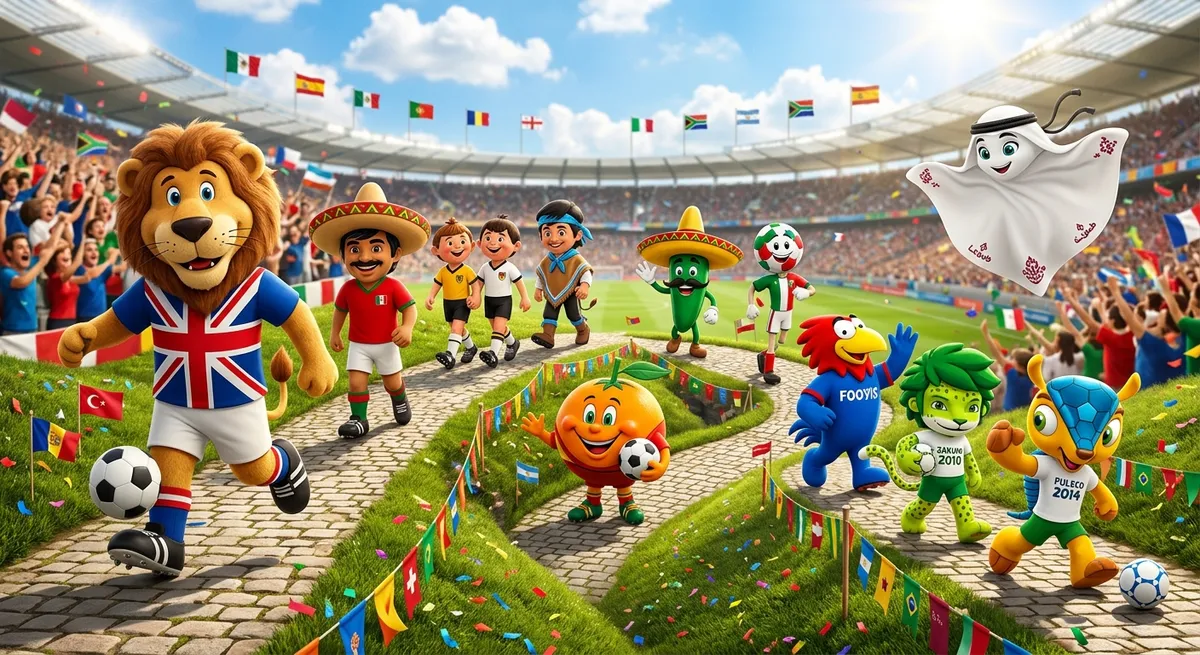
World Cup mascots are much more than simple dolls: they are the soul, culture, and identity of each edition of the World Cup. From the first English lion to the ghostly La'eeb of Qatar, these icons have evolved as much as football itself. In this article, we take a journey through the history of World Cup mascots, analyzing how each one reflected its era, its host country, and the passion of the beautiful game.
Did you know that the first official mascot only appeared in 1966? Or that there was an orange, a chili pepper, and even a cactus? We tell you everything.
The Origin: Willie (1966) and the English Revolution
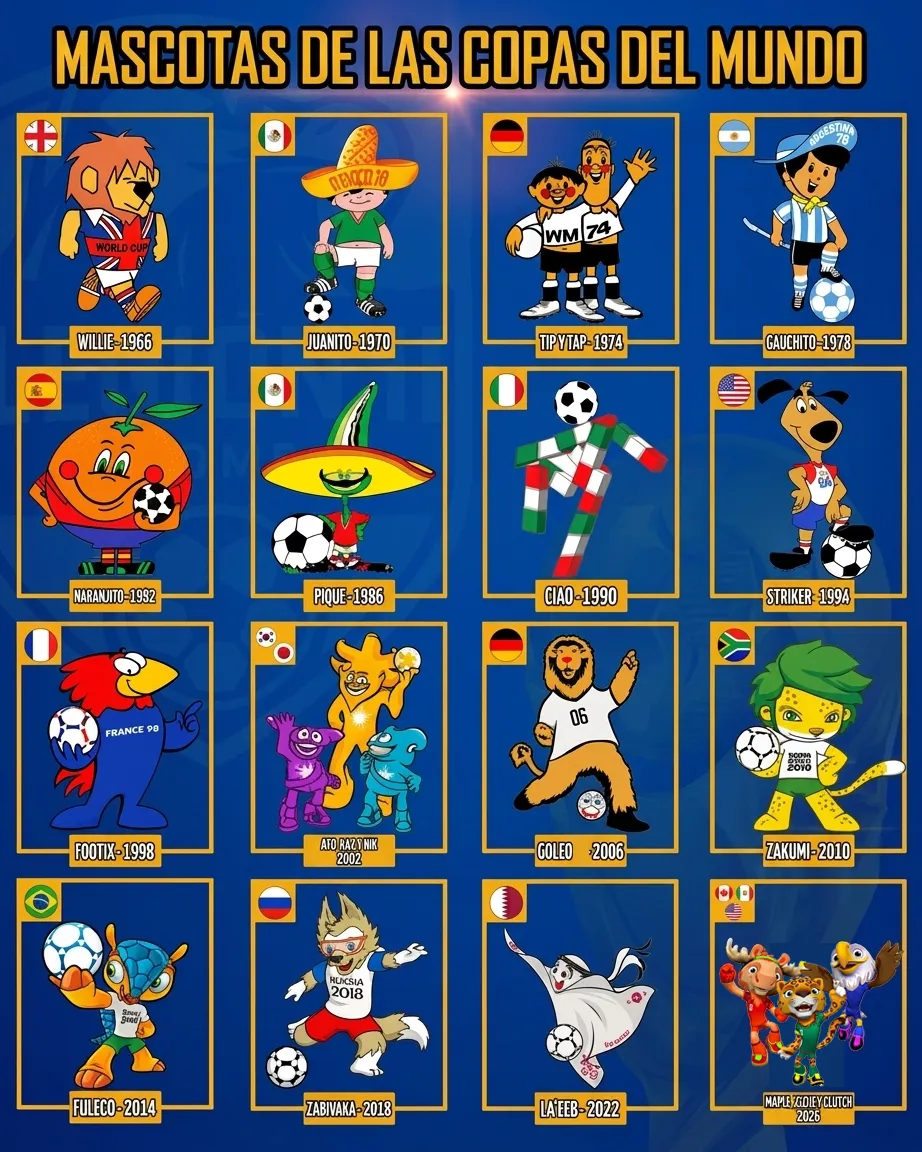
Before 1966, World Cups had no . Everything changed in England, when FIFA and the local organization decided to create , a lion with the British flag. Willie was not only the first World Cup icon: he also marked the beginning of a tradition that is now indispensable.
Meaning: Strength, English royalty, and football tradition.
Fun fact: Willie was so popular that he appeared in commercials and even in a comic.
Since then, every World Cup has had its own ambassador.
The Evolution: From Juanito (1970) to Little World Cup Naranjito (1982)
The 70s and 80s brought an explosion of creativity. Mexico 1970 introduced Juanito, a boy with a charro hat and ball. He was charming, but without today's complexity. In 1974, West Germany opted for two boys (Tip and Tap), and Argentina 1978 chose Gauchito, a gaucho with a facón knife and poncho.
The real leap came in 1982 with Naranjito, a giant orange with a face and legs. He represented the Valencian identity of Spain. Although it seems strange to us today, it was a hit: it had its own song and animated series.
"Naranjito showed that a fruit could be more famous than many players."
The Golden Years: Pique (1986) and Ciao (1990)
Mexico 1986 gave us Pique, a spicy jalapeño with a mustache and hat. His name came from "pique" (spiciness) and "picante" (spicy). He was a reflection of Mexican food. Italy 1990, on the other hand, opted for Ciao, a doll with a ball-shaped body and an Italian flag head. It was minimalist, but represented Italian design.
Both cases show how World Cup mascots began to merge sport, culture, and design.
Fuleco 2014: The Armadillo That Conquered Brazil
Brazil 2014 had Fuleco, a three-banded armadillo (an endangered species). His name combined "futebol" (football) and "ecology." Fuleco not only promoted the tournament: he also raised awareness about the environment. He was a milestone in the history of World Cup mascots for his ecological message.
Features: Blue shell, yellow body, smiling face.
Legacy: Millions of plush toys were sold and he became a global trend.
The Modern Era: La'eeb (2022) and the Mystery of the 'Kufiya'
Qatar 2022 broke all molds with La'eeb, a white, floating being with no defined gender. Inspired by the ghutra (turban) and the kufiya (Arabic scarf), La'eeb meant "skillful player" in Arabic. He was neither an animal nor a human: he was a "spirit" of football.
Impact: La'eeb generated debate, but also admiration for its abstract design.
Key phrase: "Encourages everyone to believe in themselves," according to FIFA.
What to Expect for the 2026 World Cup?
Although the context does not reveal the mascot for 2026 (USA, Mexico, Canada), we can speculate based on history. World Cup mascots usually reflect the fauna, culture, or values of the host country. It could be a bald eagle, a bison, a coyote, or even a character inspired by indigenous heritage.
Tradition says the mascot is unveiled about 12-18 months before the tournament. We'll be watching!
Key Facts About the Most Famous Mascots
Coca-Cola (1998): The rooster Footix (France) was the first to use 3D technology.
Goleo and Pille (2006): Germany presented a talking lion and a talking ball. It was criticized, but unforgettable.
Zakumi (2010): South Africa chose a green leopard (Zulu "Zaku" + "kumi" = 2010).
Conclusion: More Than Memories, They Are Living History
The history of World Cup mascots is a mirror of society: from the nationalism of the 60s to the environmentalism of 2014 and the diversity of 2022. Each mascot tells a story, generates merchandise, and remains etched in the memory of millions.
Now that we know all this, we invite you to try our prediction simulator to guess which team will be the next champion. You can also check the standings to follow the group stage.
What was your favorite mascot in history? Willie, Naranjito, Fuleco, or La'eeb?